A breakdown leaves a driver stranded when the car loses power, stalls or becomes unsafe to drive. Switch on the hazard lights, move to a safe stopping place, get everyone out through the left-hand doors, stand behind a barrier, put on hi-vis clothing, call 999 if in danger, contact the breakdown provider and leave repairs to a professional. On a motorway, use the hard shoulder and the emergency phone.
A smart motorway relies on emergency refuge areas, while an A-road or dual carriageway needs a side road or forecourt. Country lanes, roundabouts and city centres each carry their own risks. Car parks bring parking charge notices, and a breakdown at home depends on Home Start cover. Night driving calls for sidelights and locked doors. Children and pets stay behind the barrier. Drivers without cover pay for a callout, and an emergency kit keeps everyone visible and warm.
Table of Contents
Toggle1. Switch On Your Hazard Warning Lights
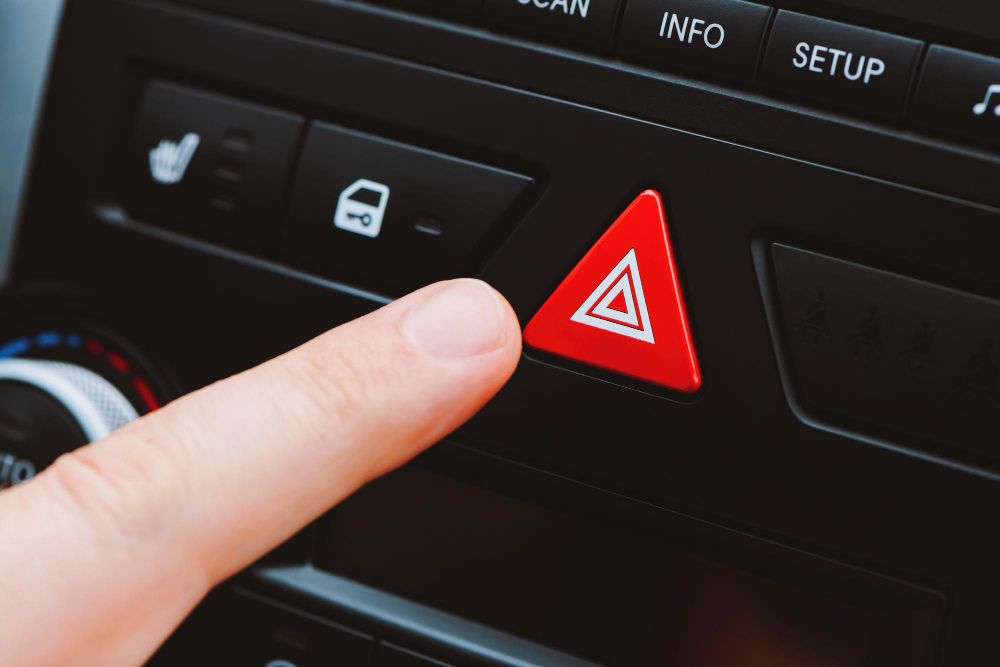
Press the red triangle button as soon as the car loses power or acts abnormally. Hazard lights warn other drivers from a distance, including those approaching a bend.
- Keep the lights on until help arrives and the car is recovered.
- Add sidelights too in darkness or fog.
2. Move Your Car to a Safe Stopping Place
Steer to the left as the car slows, and stop away from traffic. Many city roads have no verge, so use any safe gap before the car stops dead.
- Choose a lay-by, side road or petrol station forecourt.
- Apply the parking brake and turn the wheels towards the kerb.
3. Get Everyone Out Through the Left-Hand Doors
If it is safe, leave the car through the doors furthest from traffic, usually the left-hand doors. Unbuckle the youngest passengers first, then everyone else.
If leaving puts anyone in the path of traffic, stay in the car and call 999.
4. Get Behind a Safety Barrier
Move everyone away from the vehicle and behind a safety barrier, or onto the verge or pavement. Keep the group together and well back from the carriageway.
- Move further away if the engine smokes or smells of burning.
- Stay out of the space between the car and passing traffic.
5. Put On Hi-Vis Clothing and Place a Warning Triangle
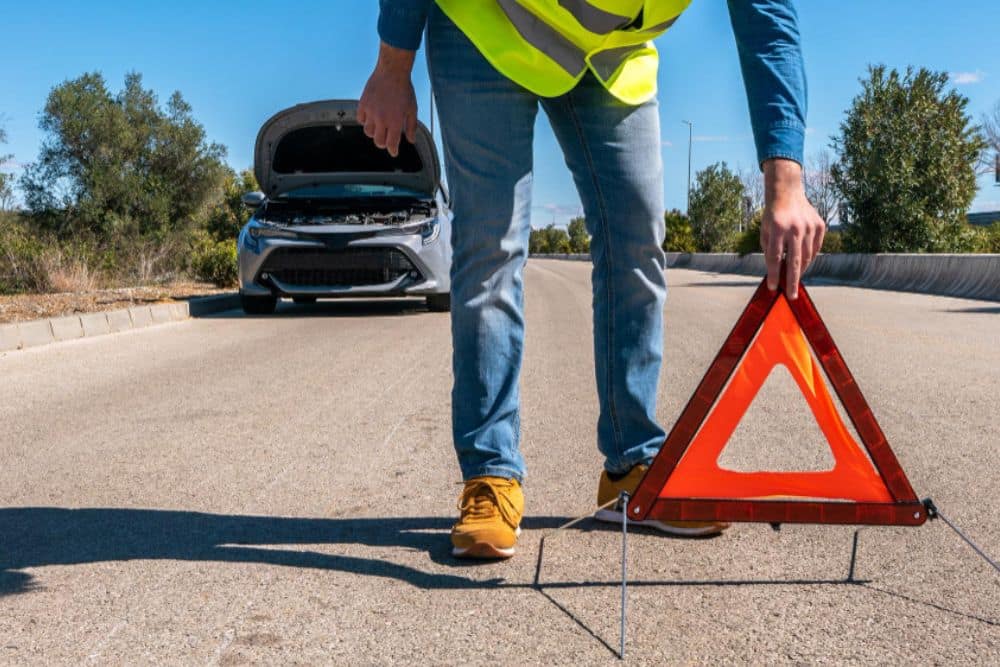
Wear a hi-vis jacket or vest if one is in the boot. Reflective clothing makes a driver visible from further away, particularly after dark.
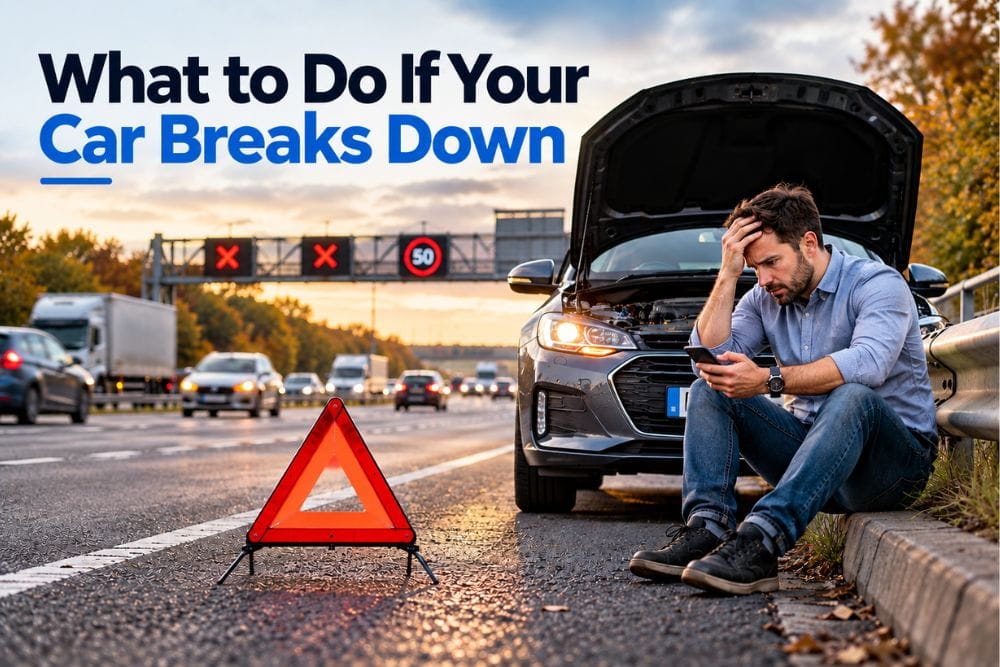
- Place a warning triangle at least 45 metres (about 50 yards) behind the car, on the same side of the road, only if it is safe to do so.
- Never use a triangle on a motorway.
6. Call 999 If You Are in Immediate Danger
Dial 999 when the car sits in a live lane, a fire starts, someone is hurt, or a stranger makes you feel unsafe. The call is free, and the emergency services ask for your exact location.
- Keep your seatbelt fastened and stay in the car if it cannot be left safely.
7. Contact Your Breakdown Provider and Share Your Location
Call your provider and give your location, vehicle registration number, make, model, colour and policy number. Mention darkness or young children.
- Use the what3words app or a map pin.
- On motorways, read the nearest marker post number.
- Switch on power saving if the battery is low.
8. Leave Repairs to a Professional Recovery Operator
Wait for a patrol, mobile mechanic or tow truck. Even simple repairs on a motorway put you in the path of fast traffic.
Check the operator’s identification before agreeing to any work. Treat unrequested tow trucks at the scene with caution. Agree the price in writing or by text before the vehicle moves.
What to Do If Your Car Breaks Down on the Motorway
If your car breaks down on the motorway, get yourself and your passengers to a safe location. Leave at the next exit or service area if the car still moves. Otherwise, stop on the hard shoulder.
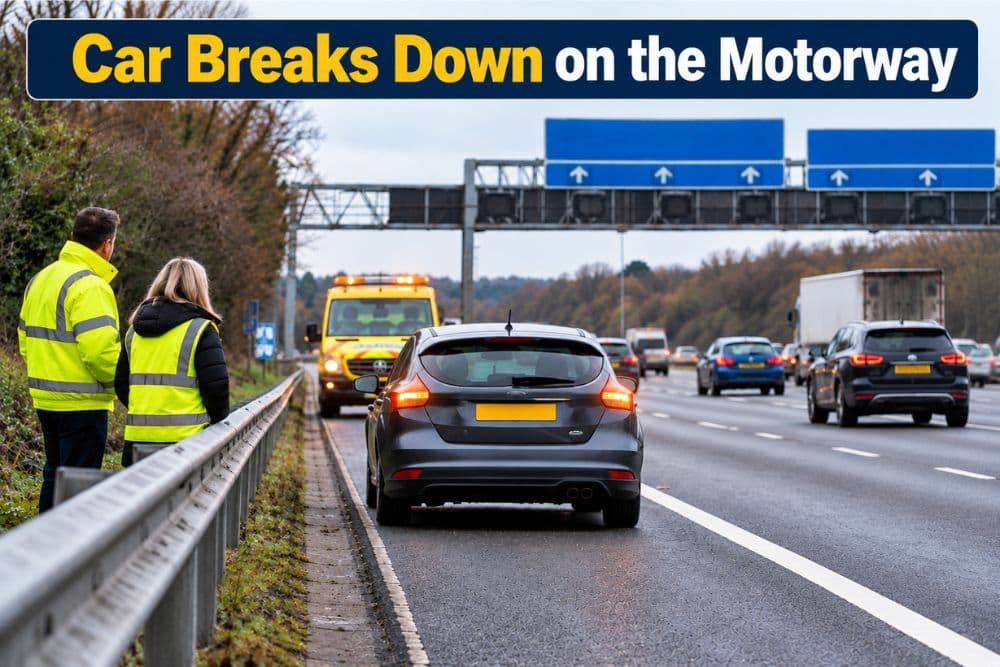
- Pull onto the hard shoulder as far left as possible.
- Switch on hazard lights.
- Exit through the left-hand doors; keep animals inside, unless it is hot and the car is unsafe.
- Stand behind the barrier, away from the carriageway.
- Walk to the nearest emergency phone, following marker post arrows, and face the traffic as you call. Otherwise, call from your mobile and read out the marker post number.
- Wait behind the barrier until help arrives.
If another person makes you feel unsafe, return to the car through a left-hand door and lock all doors. Leave again once the danger passes.
If you cannot reach the hard shoulder, keep your seatbelt fastened, switch on hazard lights and call 999. Leave the car only if you can reach a place clear of the traffic.
Around Birmingham, the M6 Toll is run by Midland Expressway, not National Highways. Its emergency phones still connect to National Highways, which contacts the M6 Toll control room. Spaghetti Junction (Gravelly Hill Interchange, M6 junction 6) has few places to stop safely. Keep driving to the next safe stopping point if the car allows.
What to Do If Your Car Breaks Down on a Smart Motorway
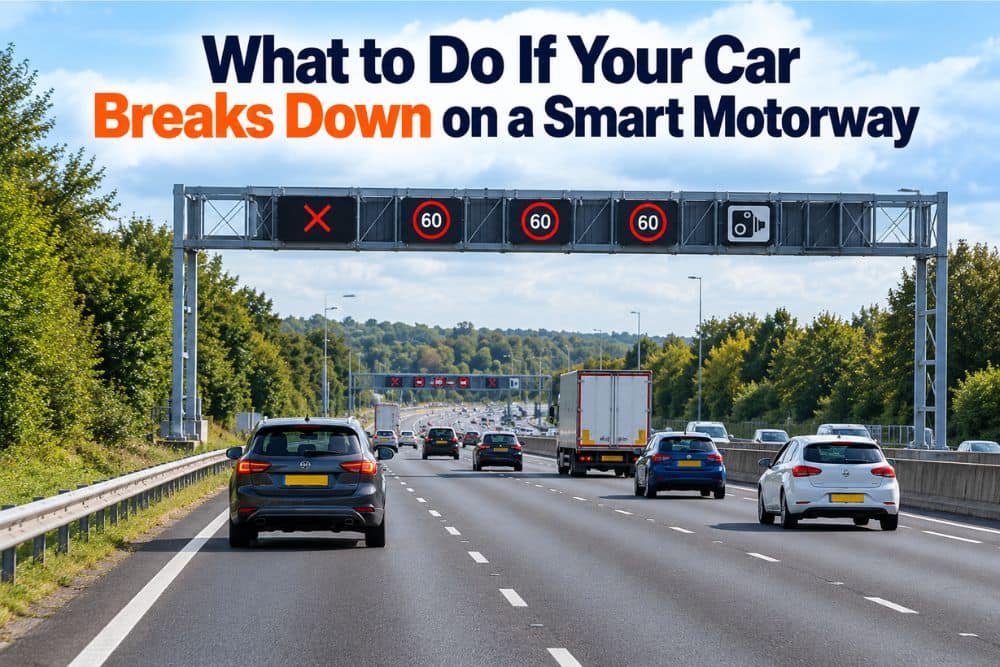
If your car breaks down on a smart motorway, and you can reach an Emergency Refuge Area (ERA) or a hard shoulder, stop there. An ERA is a lay-by with an orange road surface, marked by a blue sign with an orange SOS telephone symbol.
Smart motorways around Birmingham include the M6 between junctions 4 and 10a and the M42 between junctions 4 and 7, which use a dynamic hard shoulder. The M5 between junctions 4a and 6 has no hard shoulder.
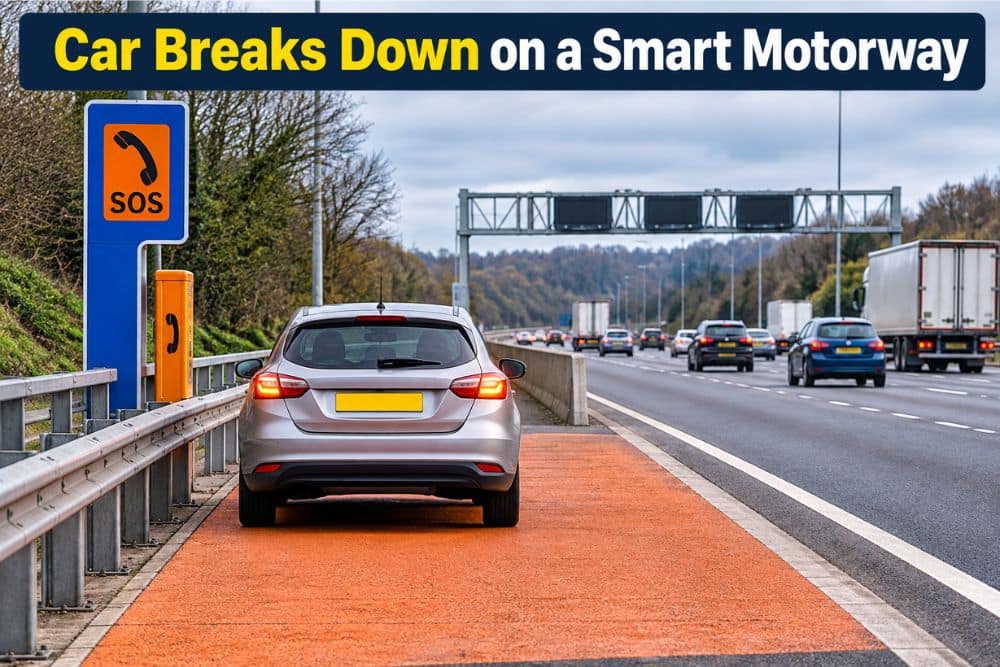
- Indicate left and move towards the next ERA.
- Stop as far left as possible inside the ERA.
- Switch on hazard lights.
- Exit through the left-hand doors and stand behind the barrier.
- Use the SOS phone, an orange emergency phone linked to the National Highways control centre.
Stopped vehicle detection (SVD) is a radar system that spots stationary vehicles. The control centre can then display a red X to close the lane and send traffic officers. A driver in a live lane still calls 999, because detection does not replace a call.
If you cannot reach an ERA, pull close to the left-hand verge, switch on hazard lights and call 999. Leave through a left-hand door only if the barrier is close and the way is clear. Otherwise, stay in the car with seatbelts on. Do not restart the car in a live lane, and do not stand between the car and the traffic.
What to Do If Your Car Breaks Down on an A-Road or Dual Carriageway
If your car breaks down on an A-road or dual carriageway, pull over safely and switch on the hazard lights. Leave through the left-hand door, away from traffic, and wait behind a safety barrier or on the verge.
Speeds on dual carriageways stay high, so passengers stand well back, behind a fence or on the embankment. On Birmingham’s A38, A45, A34 and A4540 Middleway, junctions come quickly. Use the next side road or petrol station instead of stopping where the road narrows.
- Keep everyone out of the live lane.
- Share the road name, direction and nearest junction with your provider.
What to Do If Your Car Breaks Down on a Country Lane
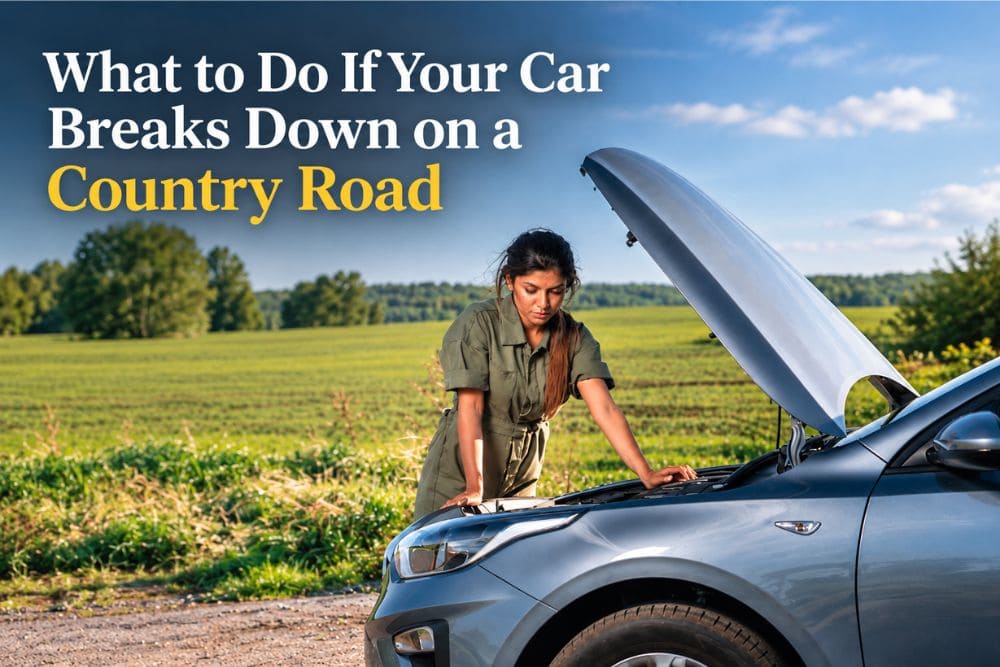
If your car breaks down on a country lane, pull as far to the left as possible and turn on your hazard lights. Everyone then exits through the left-hand (passenger) door. Rural lanes around Solihull, Meriden and the Lickey Hills have blind bends, and signal can drop.
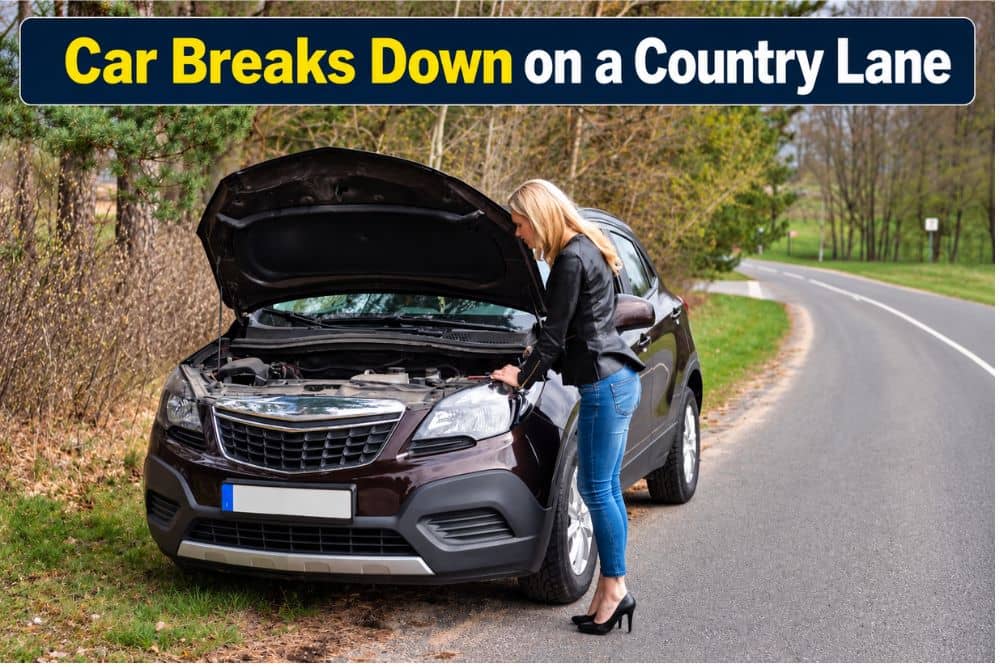
- Avoid stopping on a bend or the brow of a hill.
- Walk to higher ground or the nearest junction if signal drops.
- Call 101 to report a car blocking the lane when no one is in danger.
Share a what3words address with your provider. Lane names repeat across areas, and a what3words address points to one exact 3-metre square.
What to Do If Your Car Breaks Down on a Roundabout
If your car breaks down on a roundabout, steer it off at the nearest exit straight away. If that fails, pull up near the left-hand edge, clear of traffic leaving the roundabout.
- Switch on hazard lights.
- Stand clear of the entry and exit lanes.
- Call 999 if the car blocks a live lane and cannot move.
- Call your provider once everyone is safe.
What to Do If Your Car Breaks Down in a Town or City Centre
If your car breaks down in Birmingham city centre, move to the nearest safe kerb and switch on the hazard lights. Then contact your breakdown provider or a local recovery service.
Avoid bus lanes, junctions and loading bays where possible, because restricted areas can lead to penalty notices. Raising the bonnet is a common sign of a fault, though not an official one. Do it only when standing clear of traffic. In the A38 Queensway tunnels, switch on hazard lights, switch off the engine and use the emergency phone.
What to Do If Your Car Breaks Down in a Car Park
If your car breaks down in a car park, switch on your hazard lights immediately and move the car to a safe or empty bay if possible. Then contact your breakdown provider.
Tell car park staff if any are on site. Automatic number plate recognition (ANPR) cameras record how long a vehicle stays, so a parking charge notice can follow.
- Photograph the car, the bay and the ticket machine.
- Ask staff about free-parking time limits and how to extend your stay.
- Keep your ticket and the provider’s confirmation message.
What to Do If Your Car Breaks Down at Home
If your car breaks down at home, check your policy details or contact a provider for assistance. Home Start covers a breakdown at or near home. Many policies sell it as an add-on, and some higher tiers include it.
Many policies exclude breakdowns within about a quarter of a mile of home unless Home Start is included. Book a slot through the provider’s app or phone line, and share the registration number at the time.
What to Do If Your Car Breaks Down at Night
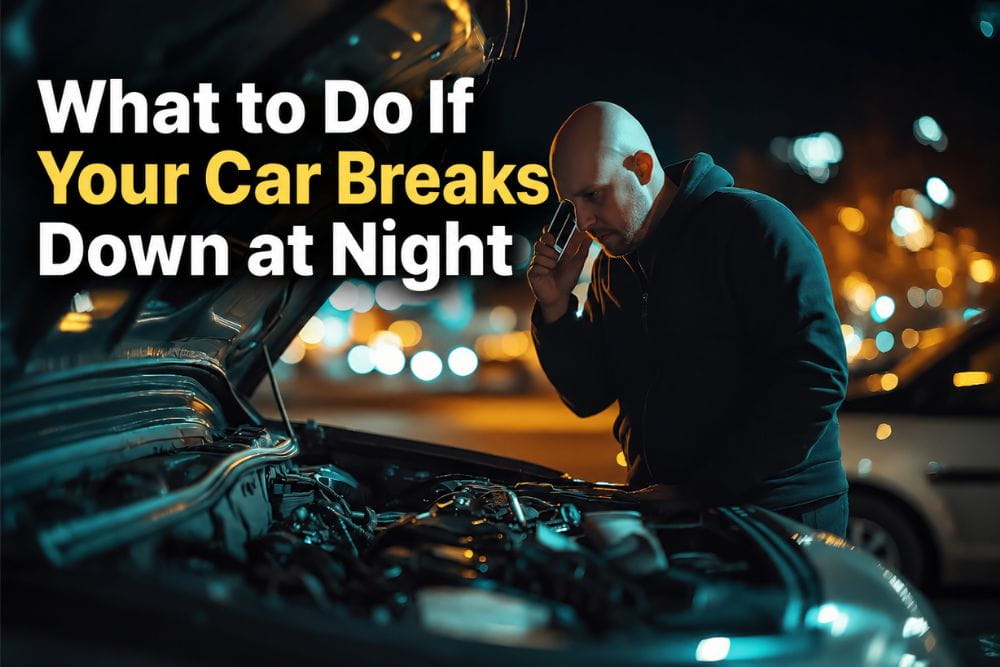
If your car breaks down at night, turn on your hazard lights and sidelights immediately and pull over to a safe area away from traffic. On a busy road or motorway, exit through the passenger-side door.
Poor visibility and fog raise the risk of a collision at the roadside.
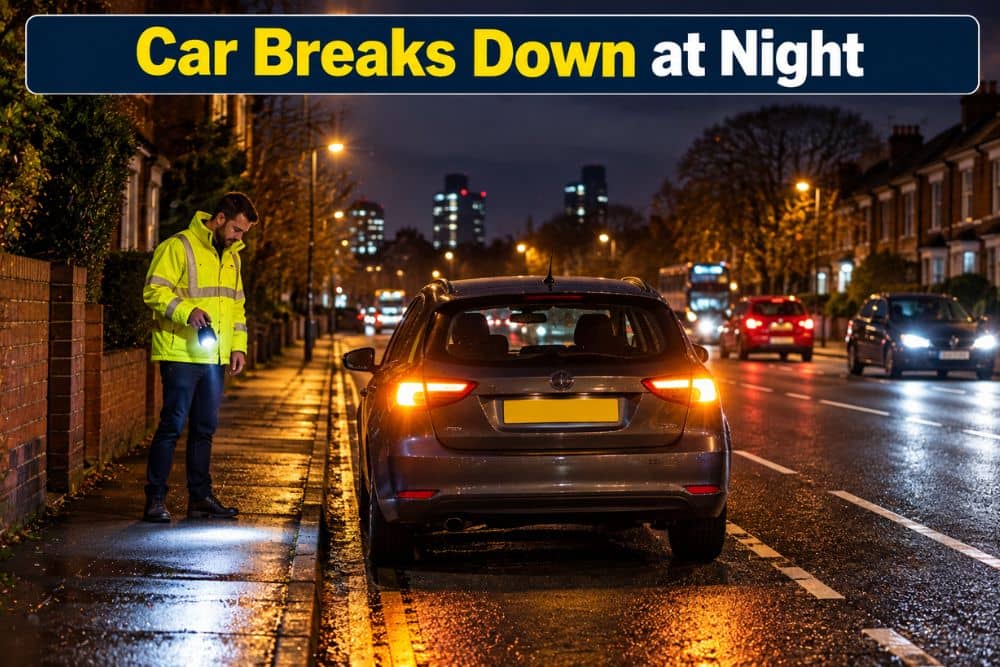
- Stand where you do not block the car’s lights from approaching drivers.
- Use a torch to see your footing, not to signal traffic.
- Keep doors locked if waiting inside.
- Call 999 if someone approaches and makes you feel unsafe.
- Tell the provider if you are a lone driver or travelling with children.
What to Do If Your Car Breaks Down with Children or Pets
When your car breaks down with children or pets, move everyone to a safe location away from fast-moving traffic. Keep children close and under control at all times. Vulnerable passengers stand behind the barrier, with an adult between them and the traffic.
- Keep children together, away from the carriageway.
- Hold young children’s hands or carry them.
- Keep pets inside the car when it is safe and cool. In hot weather, or if the car is unsafe, take pets behind the barrier on a lead.
Tell the provider about children or pets when calling. The provider can then advise on the safest next step.
What to Do If You Do Not Have Breakdown Cover
If you do not have breakdown cover, call a national provider or a local recovery firm and pay for the callout. National providers sell cover on the spot, usually at a higher price than a policy bought in advance.
Get everyone to a safe place before making any call. Then choose one of these routes:
- Ask a national provider for pay-as-you-go help or instant membership.
- Phone a local recovery firm or garage for a second quote.
- Use the orange emergency phone on a motorway. The call is free, but the recovery is not.
- Ask for the total price, including VAT and mileage, before the vehicle moves.
What Should Be in Your Breakdown Emergency Kit?
Your breakdown emergency kit holds the items that keep you visible, warm and reachable during a long wait. Keep it in the boot, because a wait on the M6 or M5 becomes safer with one, especially in winter.
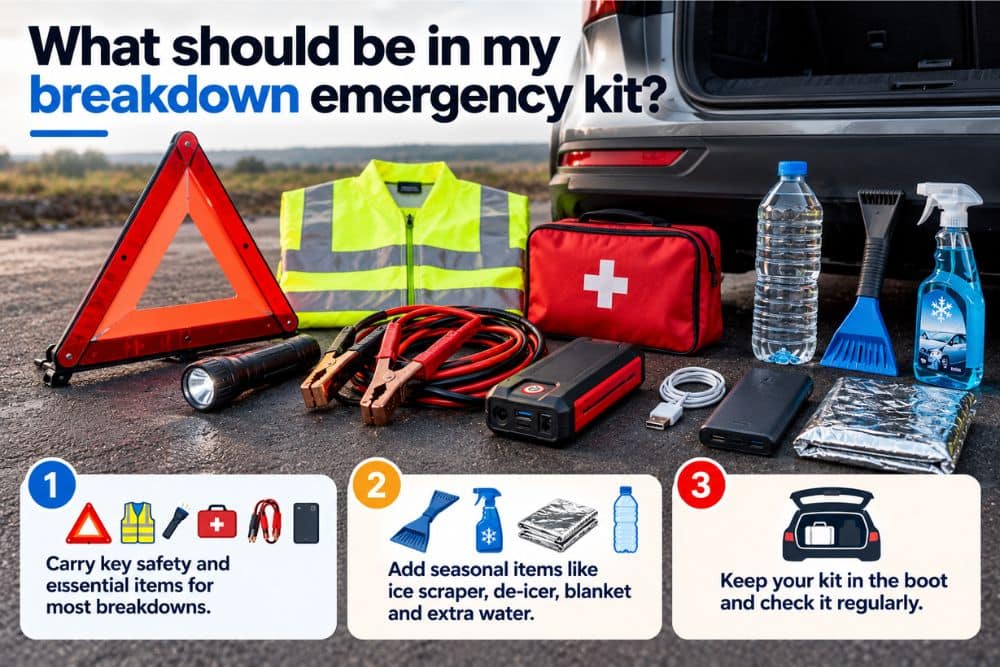
- Torch with spare batteries
- Charged power bank and cable
- Hi-vis jackets for every adult
- Warning triangle
- Blanket and warm coat
- Water and snacks
- First aid kit
- Jump leads
- Spare warm clothing for children
- Pet water and a bowl
Final Thoughts
When your car breaks down, stop in the safest place available, switch on the hazard lights and move everyone behind a barrier. If the car stops in a live lane, stay inside with your seatbelt on and call 999. Call 999 if anyone is in danger too. Otherwise, call your breakdown provider and give your exact location. Keep a charged power bank, a torch and hi-vis jackets in the boot, and agree the price before any recovery.
Frequently Asked Questions
Q: How to know if your car is about to break down?
A: Your car is about to break down when a red warning light appears, the engine overheats or the car loses power. Grinding, knocking or squealing noises, burning smells and fluid leaks under the car are also warning signs.
Switch on the hazard lights, stop at the first safe place and call your breakdown provider. Driving on to see how far the car goes risks a stop in a live lane.
Q: What is the distress signal for a broken-down car?
A: Hazard warning lights are the standard signal for a broken-down car. The red triangle button flashes all indicators together and warns approaching drivers that the car has stopped.
On roads other than motorways, a warning triangle placed at least 45 metres behind the car adds a second signal, but only if placing it is safe. Never place a triangle on a motorway.
Q: Do I have to stay with my car after it breaks down?
A: You do not have to stay inside your car after it breaks down. On a motorway or other high-speed road, leave through the left-hand doors and wait behind the safety barrier, well clear of the vehicle.
One exception applies in a live lane. If the car stops where leaving is unsafe, keep your seatbelt fastened, leave the hazard lights on and call 999.
Q: Can I leave a broken-down car at the roadside?
A: Not on a motorway or any other high-speed road, where the car needs recovery. On a quiet local street, a car can stay briefly if it is legally parked, taxed and insured. It must not block a driveway, cause an obstruction or sit in a no-parking or clearway zone. A car that looks abandoned, with flat tyres, broken windows or missing plates, can be investigated and removed by the local council.
Q: What should I remove from my car if I leave it unattended?
A: Remove valuables, such as bags, electronics and satnavs, or keep them out of sight. Lock the car if it is safe to walk away from it.
Q: How much does a car breakdown cost?
A: Car breakdown cost depends on when you arrange help. Annual cover bought in advance costs far less than a callout without a policy. Recovery firms price a callout by distance, vehicle type and time of day. Agree the price in writing before the car moves.
Q: Will a breakdown show up on my insurance record?
A: In most cases, no. A breakdown callout does not appear on your car insurance record, because breakdown cover is separate from motor insurance. A callout is not an insurance claim, so it does not usually affect your no-claims discount.
An accident is different. If a collision causes damage and you claim on your motor policy, the claim is recorded. Breakdown providers also set their own limits on callouts per year, and those limits apply to breakdown cover only.