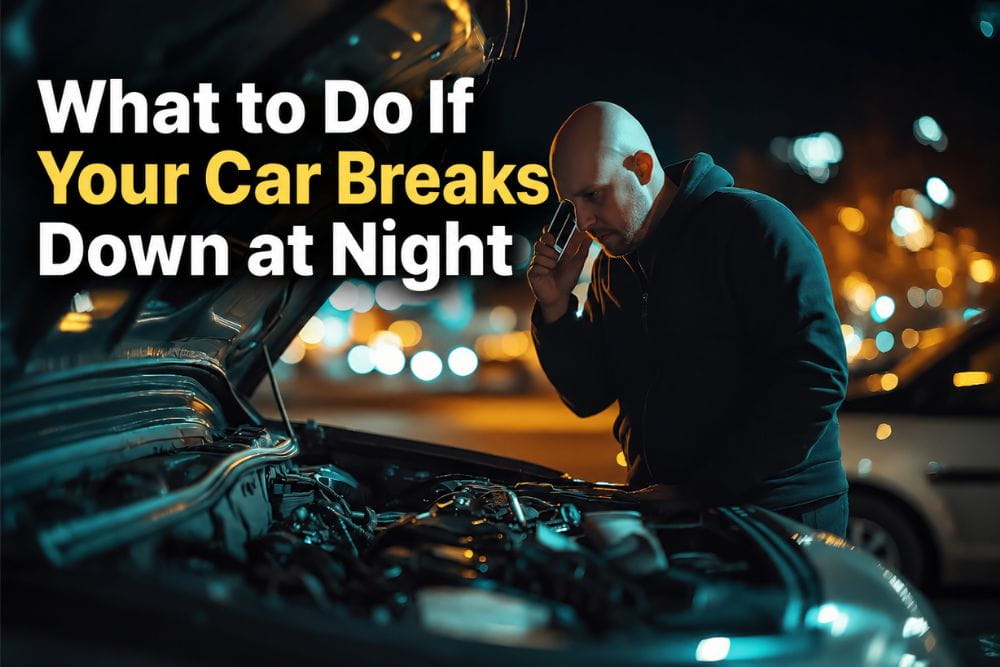
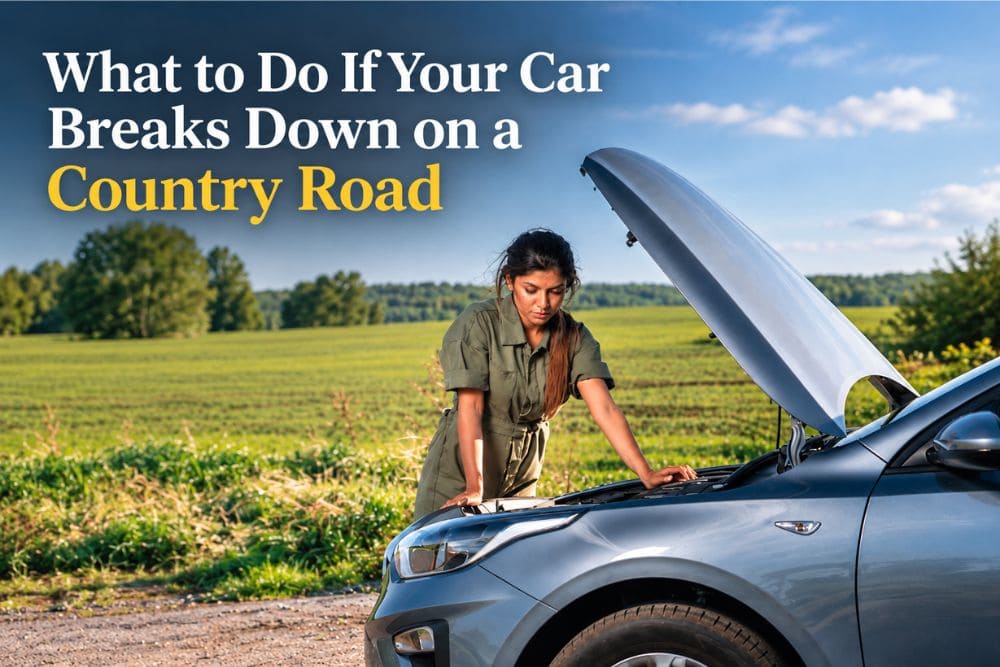
When a car breaks down on a country road, five actions protect the scene: steering onto a safe verge, switching on the hazard warning lights and sidelights, exiting on the side away from traffic, placing a warning triangle 45 metres behind if it is safe to do so and calling 999 or a breakdown provider. Where it is safe, waiting behind a hedge, fence or bank is safer than staying inside the car.
Emergency roaming, satellite messaging, a vehicle SOS button and a saved GPS location bring help when signal is weak. Across the West Midlands, the M6, the B4102 Solihull Road, the B4551 Bromsgrove Road, Illey Lane and Penkridge Bank Road need extra care. Country roads differ from the M6 and M42 in warning triangle use, waiting position and collision risk. Recovery operators shield the scene, assess the fault and winch the car onto a flatbed. A verge allows a brief stop before obstruction and abandonment rules apply. Checks on tyres, the battery, fluids and fuel, plus low-gear driving and an emergency kit, reduce rural breakdown risk.
Table of Contents
Toggle1. Steer Your Car Onto a Safe Verge
Steer your car onto a wide verge, lay-by or field gateway while the vehicle still has momentum. A stopping point with clear sight lines gives approaching drivers time to react. Four positions leave a stationary car hidden or blocking traffic: blind bends, hill crests, narrow bridges and passing places.
- Blind bends, where drivers round the corner with no warning
- Hill crests, which hide the car until the final seconds
- Narrow bridges, which leave no room for passing traffic
- Passing places on single-track lanes, which other drivers depend on
2. Switch On Your Hazard Warning Lights and Sidelights
Switch on your hazard warning lights if the car is causing an obstruction. Hazard lights mark the vehicle as stationary rather than slow-moving. Keep the sidelights on after dark or in poor visibility.
Most country lanes across the West Midlands have no street lighting. A car’s own lamps form the only warning for drivers approaching at up to 60 mph, the national speed limit for cars on single carriageways.
3. Exit the Car on the Side Away From Traffic
Exit the car on the side furthest from traffic, usually the left-hand side. The nearside doors open onto the verge rather than the carriageway. Three actions keep everyone safe during the exit: getting children out, keeping pets contained and putting on a high-visibility jacket.
- Get everyone out on the nearside straight away, and keep children close and away from the road.
- Keep dogs inside the car unless conditions make that unsafe; a loose animal on an unlit lane creates a second hazard.
- Put on a high-visibility or reflective jacket before stepping away from the car.
- Never stand between the car and passing traffic.
4. Place a Warning Triangle 45 Metres Behind the Car, If Safe
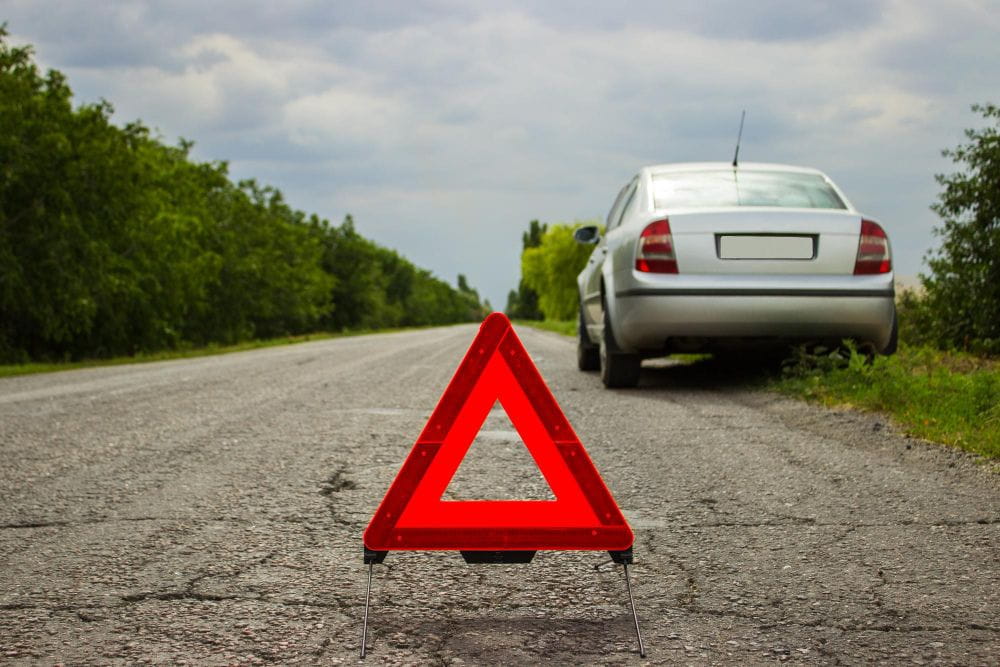
Place a warning triangle at least 45 metres (147 feet) behind the car, on the same side of the road, but only if it is safe to do so. Take great care when placing and retrieving it.
On a blind bend, in a narrow lane or in the dark, do not walk far along the road to set the triangle. Stay on the verge and wear a high-visibility jacket. Carrying a warning triangle is not a legal requirement in the UK, unlike in France. On motorways, never use one.
5. Call 999 or Your Breakdown Provider
Call 999 if the car blocks the road or anyone is in danger. Otherwise, call your breakdown provider. Four scenarios decide the number to call: a dangerous blockage, a minor obstruction, a safe stop with breakdown cover and a safe stop without cover.
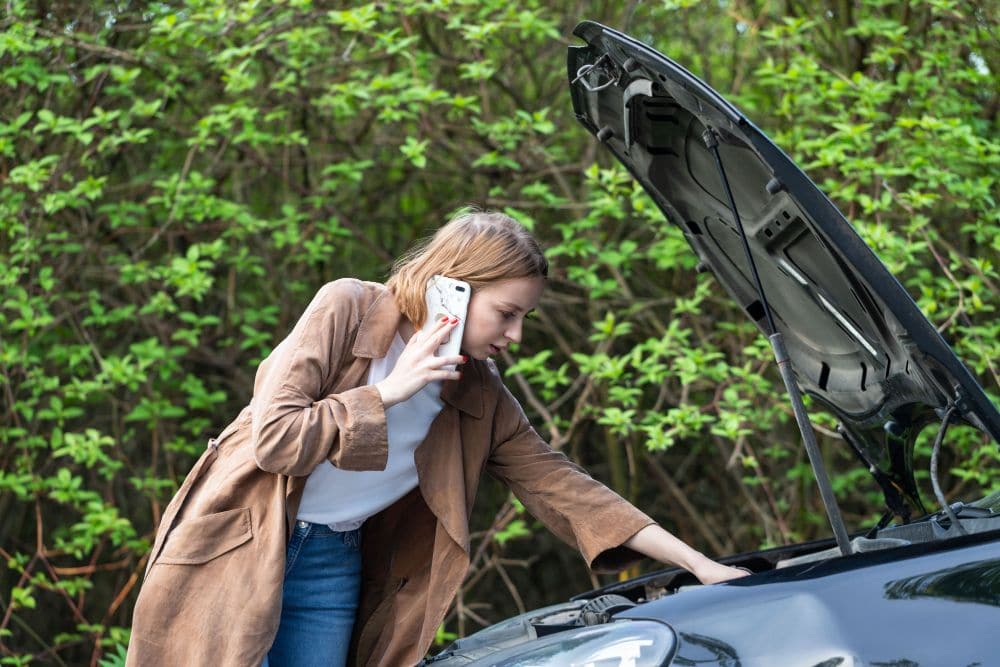
| Situation at the scene | Number to call |
|---|---|
| Car blocking a fast road, or someone injured | 999 |
| Car partly obstructing a quiet lane, nobody in danger | 101 (police non-emergency); call 999 if danger develops |
| Car safely off the road, breakdown cover in place | Your breakdown provider |
| Car safely off the road, no breakdown cover | A local pay-on-use recovery operator, such as pay-on-use car recovery in Birmingham |
Tell the call handler:
- Your vehicle registration
- The road name or number, and the nearest junction or landmark
- The nature of the fault
- How many people are with you, including any children or anyone who cannot leave the car
Should You Stay in Your Car After It Breaks Down on a Country Road?
No, you should generally leave the car if you can reach a safe place, because a stationary vehicle on a narrow lane remains exposed to drivers who see it too late. Two waiting rules and two exceptions apply: wait behind a barrier and stand clear of the car, and stay inside only when no safe way out exists or a passenger cannot exit.
- Wait behind a fence, hedge or raised bank, well clear of the tarmac. Watch for ditches, drops and uneven ground, especially after dark.
- Stand away from the front, rear and sides of the car; a rear impact shunts the vehicle forward.
- Do not attempt repairs on a busy road.
- Stay inside if you cannot get out safely or reach a safe place. Keep your seatbelt and hazard lights on, and call 999.
- Stay inside if a disability or injury prevents a safe exit, and call 999.
Return to the vehicle only when the recovery operator confirms it is safe.
How Do You Get Help When Your Car Breaks Down on a Country Road With No Signal?
To get help when your car breaks down on a remote country road with no signal, use six options: emergency roaming, satellite messaging, emergency SMS, a vehicle SOS button, higher ground and a saved location record.
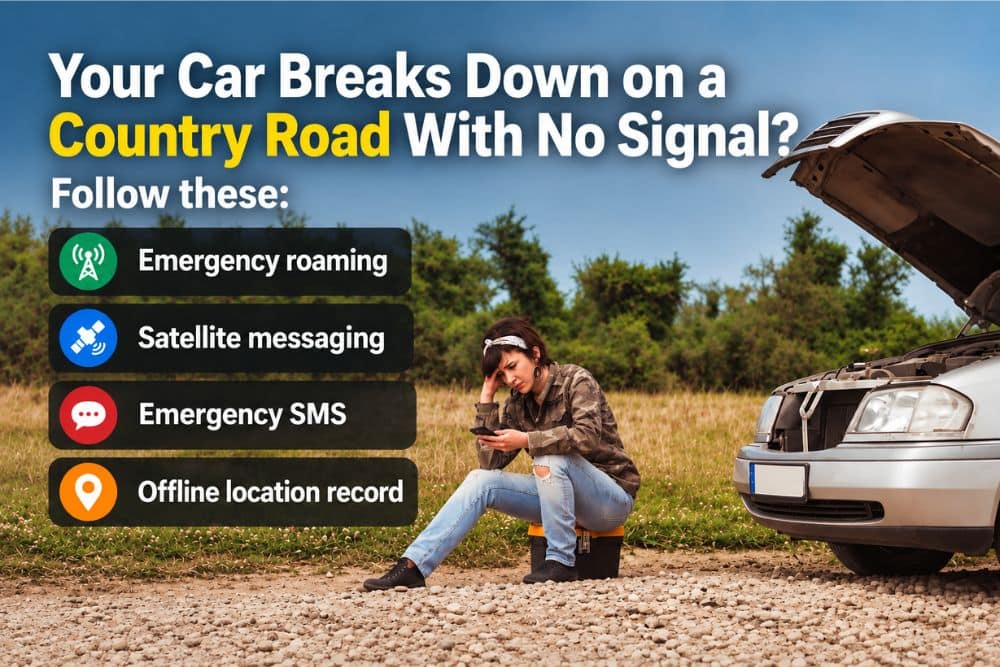
- Dial 999 or 112 even when the screen shows “No Service” or “Emergency Calls Only”. Since 2009, UK mobile phones have roamed onto any available network for emergency calls when their own network has no coverage. Roamed calls carry less accurate location data, and the call handler cannot ring back.
- Use satellite messaging on a supported iPhone. When a 999 call fails, the phone offers a satellite text to emergency services.
- Send an emergency SMS to 999 if you are deaf, hard of hearing or speech-impaired and registered in advance.
- Press the SOS button if your vehicle has one.
- Walk to higher ground only when the car sits fully off the road.
- Note your exact location. Drop a pin in Apple Maps or Google Maps, or read the latitude and longitude from your phone. GPS works without mobile signal, so you can read the figures out to the call handler.
- Note the road name or number, the nearest junction, a landmark or the number on a nearby telegraph pole.
- Download offline maps before a long rural journey.
Which West Midlands Roads Need Extra Care When a Car Breaks Down?
On smart motorways, a broken-down car may stop in a live lane, so emergency areas matter. Country roads present a different danger: no barriers, no emergency areas and little room to move. Five stretches need extra care across the region: the M6 between Junctions 4 and 10A, the B4102 Solihull Road, the B4551 Bromsgrove Road, Illey Lane and Penkridge Bank Road.
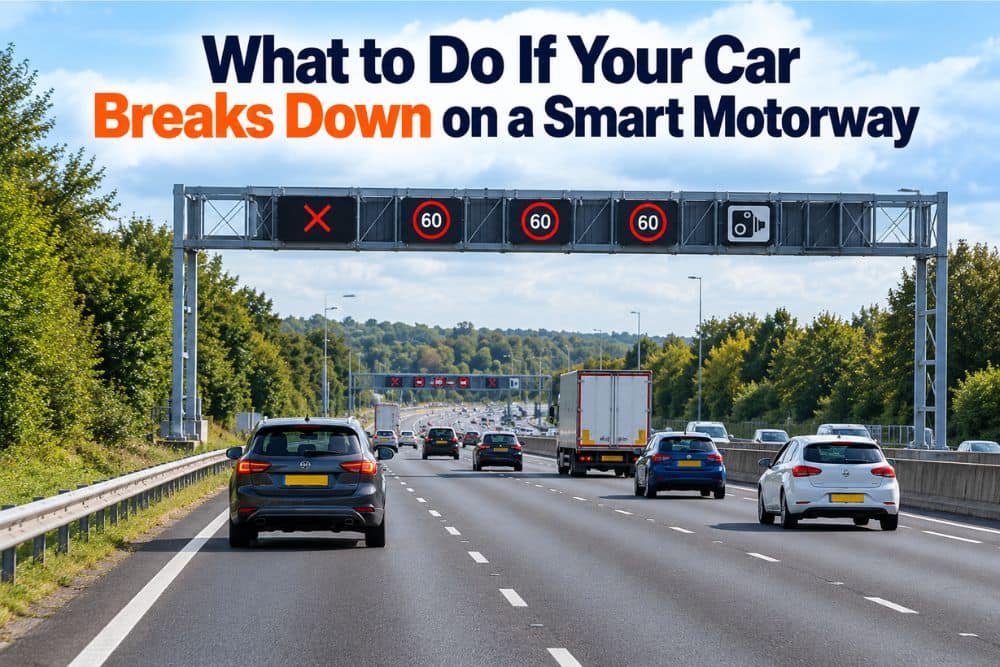
- M6, Junctions 4 to 10A: a smart motorway stretch where the hard shoulder may open to traffic at busy times. Emergency areas sit at regular intervals, and a Red X means the hard shoulder is closed.
- B4102 Solihull Road, Meriden Gap: a tree-lined rural route between Hampton-in-Arden and Catherine-de-Barnes.
- B4551 Bromsgrove Road, Romsley: a winding rural route with several narrow side roads joining it.
- Illey Lane: a narrow, unlit blind corner with no spare width.
- Penkridge Bank Road, Cannock Chase: a wooded route with ditches and poles close to the carriageway. Deer crossings along the Chase become more frequent between October and December.
How Is a Car Breaking Down on a Country Road Different From the M6 or M42?
A car breaking down on a country road faces slower recovery access but fewer lanes of traffic, while the M6 and M42 carry fast multi-lane traffic with strict safety rules. Six factors separate the two settings: traffic speed, stopping place, warning triangle use, waiting position, collision risk and help on scene.
| Factor | Country road | M6 or M42 |
|---|---|---|
| Traffic speed | Up to 60 mph for cars on single carriageways | Up to 70 mph or variable limits across several lanes |
| Stopping place | Verge, lay-by or field gateway | Service area, next exit, emergency area or hard shoulder |
| Warning triangle | At least 45 metres behind the car, if safe | Never use one |
| Waiting position | Behind a hedge, fence or bank | Behind the safety barrier, well away from the car |
| Main collision risk | Late sighting on bends and crests | Secondary collision from following traffic |
| Help on scene | Breakdown provider or police | National Highways traffic officers, police or breakdown provider |
Dual carriageways such as the A38 and A45 sit between the two: speeds match motorways, but many stretches lack a hard shoulder.
What Happens When Recovery Reaches a Car Broken Down on a Country Road?
When a breakdown recovery vehicle reaches you on a country road, the operator works through four stages: shielding the scene, assessing the fault, loading the car and confirming the destination.
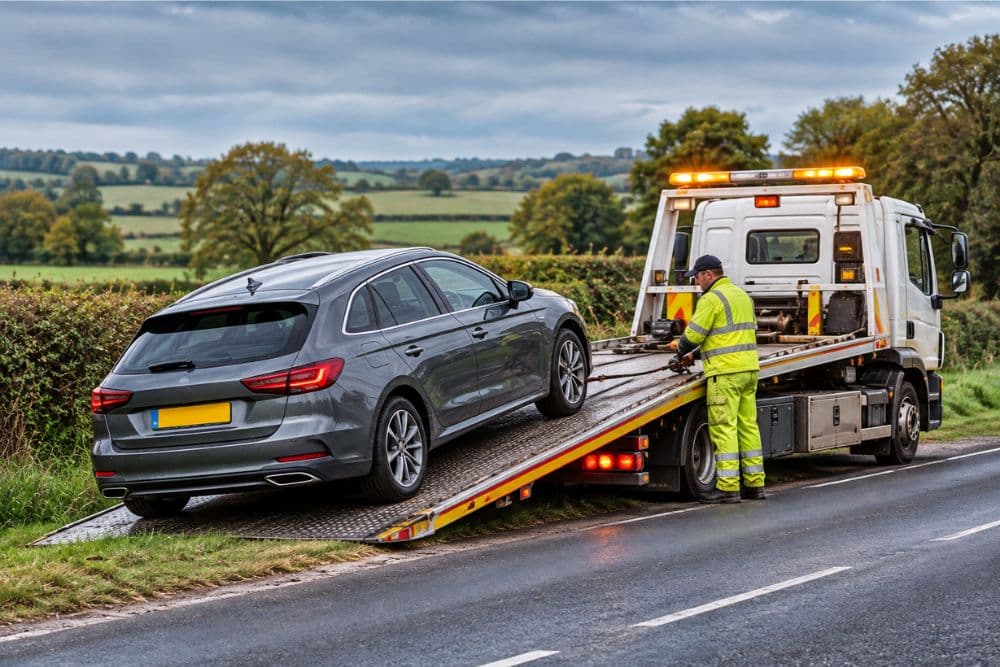
- Shields the breakdown by parking the recovery truck behind the car with amber beacons running.
- Assesses the fault: flat batteries and punctures often receive a roadside repair, while brake, steering or fluid-leak faults lead straight to recovery.
- Loads the car: a winch attached to the towing eye pulls a non-running vehicle onto the flatbed, and wheel straps hold it in place for uneven lanes.
- Confirms the destination, such as home, a chosen garage or the nearest workshop, under the cover policy or pay-on-use agreement.
Electric and four-wheel-drive cars often travel on a flatbed, because towing on their wheels risks drivetrain damage.
Can You Leave a Broken-Down Car on a Rural Road Verge?
No, you cannot leave a broken-down car on a rural road verge in the West Midlands for long, because a stationary vehicle soon counts as an obstruction or an abandoned vehicle. A taxed and insured car can wait briefly where stopping is permitted. A longer stay exposes the registered keeper to four risks: obstruction, abandonment, theft and removal charges.
- Obstruction: West Midlands Police can remove a vehicle that endangers other road users and issue a penalty.
- Abandonment: Birmingham City Council and Solihull MBC inspect reported vehicles and serve removal notices.
- Theft and vandalism: isolated verges attract opportunistic crime.
- Removal charges: statutory removal and storage fees fall on the registered keeper.
How Can You Stop Your Car Breaking Down on Rural Roads?
You can stop your car from breaking down on rural roads by checking six areas: tyres, battery, fluids, fuel, gear use and the emergency kit.
- Check tyre pressure and tread depth every fortnight; potholes and loose gravel punish under-inflated tyres.
- Test the battery before winter. A flat 12-volt battery is among the most common causes of breakdowns.
- Top up coolant and oil only when the engine is cold.
- Keep at least a quarter tank of fuel; filling stations thin out beyond the Birmingham suburbs.
- Select a lower gear on steep descents around the Clent and Lickey Hills to protect the brakes.
- Pack a torch, power bank, blanket, water and a high-visibility jacket in the boot.
Final Thoughts
A car that breaks down on a country road stays safest when three conditions meet: clear visibility, distance from passing traffic and a precise location. Unlit lanes, blind bends and patchy signal across the West Midlands turn every minute of delay into added risk. A breakdown provider’s number saved in the phone, offline maps downloaded and an emergency kit in the boot shorten that delay before the journey begins.
Frequently Asked Questions
Is a warning triangle a legal requirement in the UK?
No, UK law does not require drivers to carry a warning triangle. UK road rules recommend placing one at least 45 metres behind a broken-down car on roads other than motorways.
Does a warning triangle go before or after a bend?
A warning triangle goes before the bend. Drivers then receive the warning before the car comes into view, rather than after rounding the corner.
Is it safe to wait in the car on an unlit lane at night?
Waiting outside behind a hedge or bank is safer when a refuge exists. On unlit forest roads across Cannock Chase, deer activity and late sighting raise the collision risk for a stationary car.
Who pays for recovery without breakdown cover?
The driver pays the recovery operator directly. Pay-on-use operators set the charge by distance, vehicle type and time of day.
Can a flatbed truck reach a car stuck in a ditch?
Yes, in most cases. The operator winches the car out of the ditch and onto the flatbed from the road, provided the lane offers room to position the truck.