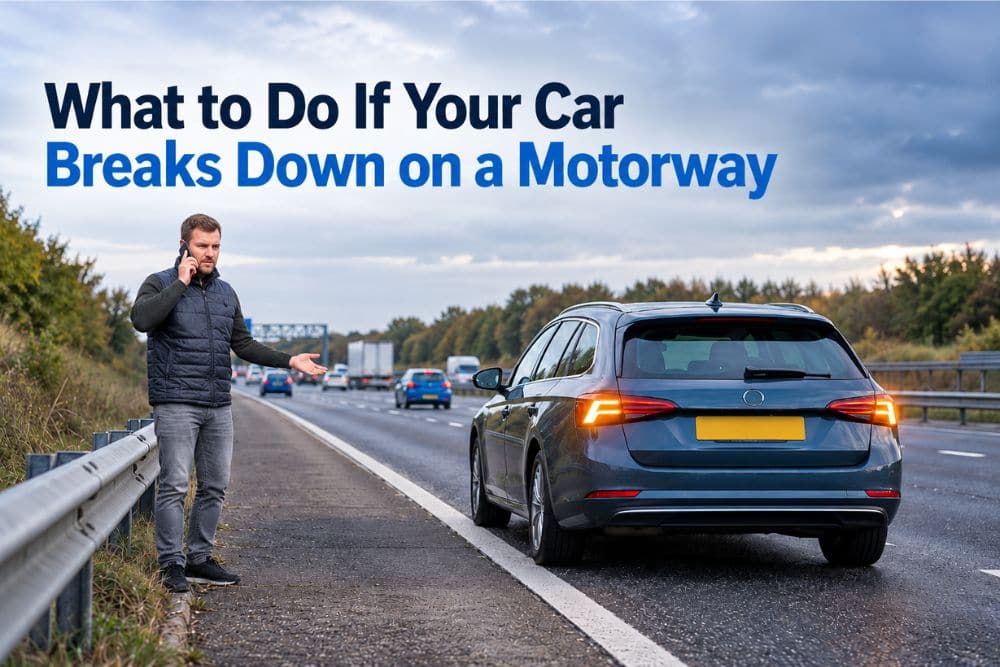
A motorway breakdown follows a fixed sequence. Leave at the next exit or service area if the car stays controllable, meaning it steers normally and keeps some power. Otherwise, stop on the hard shoulder or in an emergency refuge area, switch on the hazard warning lights and sidelights, exit through the left-hand doors, wait behind the safety barrier, and call the breakdown provider or the emergency roadside telephone with your exact location. Drivers also need to know what not to do during a motorway breakdown, such as placing a warning triangle or attempting repairs.
Specific rules apply if the car stops in a live lane, breaks down in motorway roadworks or suffers a tyre blow-out. Electric cars, vans and motorbikes need different recovery steps, and certain warning signs demand an immediate stop. Motorway recovery, free recovery cover, rejoining the motorway, the legality of stopping or leaving a car, journey preparation and the questions drivers ask most complete the picture.
Table of Contents
Toggle1. Leave the Motorway at the Next Exit or Service Area
A motorway exit or service area is a place of relative safety. Leave the motorway there if the car stays controllable.
- A controllable car steers normally, holds a straight line and keeps some power.
- A car that has lost power, steering weight or braking cannot reach the exit. Stop on the hard shoulder or in a refuge area instead.
- A car with a flat or damaged tyre is also not controllable. Treat it as a stop-now case.
2. Stop on the Hard Shoulder or in an Emergency Refuge Area
The hard shoulder is the left-hand strip beside lane one on a conventional motorway. An emergency refuge area (ERA) is a bay on a smart motorway where no hard shoulder exists. ERA surfaces are orange, and blue signs with an SOS telephone symbol mark them.
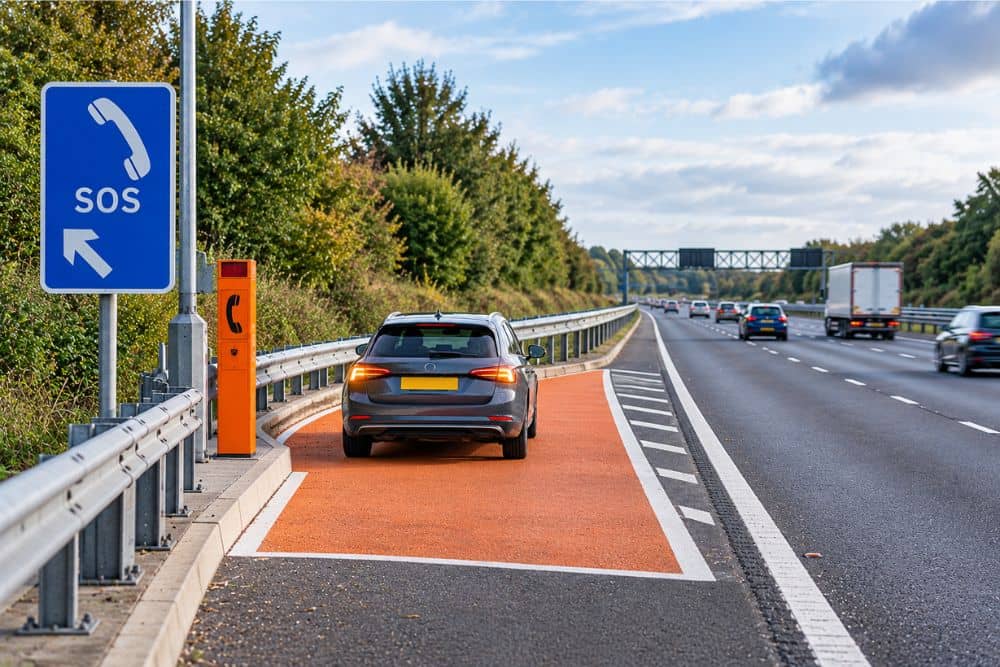
- Move to the far left as early as possible.
- Pull into the hard shoulder or refuge area.
- Stop with the wheels turned to the left.
- Leave space in front to open the doors and exit.
Turned wheels send a car that is struck from behind toward the verge, not back into the traffic lanes.
3. Switch On the Hazard Warning Lights and Sidelights
Hazard warning lights go on as soon as the problem starts. Sidelights go on too in darkness, fog or heavy rain. Front and rear sidelights make a stationary car visible at distance.
4. Exit the Car Through the Left-Hand Doors
The left-hand side is the side furthest from traffic. Every occupant exits that way.
- Slide across and leave by the passenger seat if the driver’s door faces traffic.
- Put on a hi-vis vest before stepping out.
- Bring all passengers, including children, out on the same side.
- Leave pets inside, behind closed windows. A loose animal on a motorway is a hazard to itself and to traffic.
Staying beside the car is a common mistake. A rear-end strike on a stationary car injures anyone standing near it.
5. Move Behind the Safety Barrier and Wait Away From Traffic
The safety barrier is the steel or concrete rail at the edge of the carriageway. The ground beyond it, a grass verge or embankment, is the waiting area.
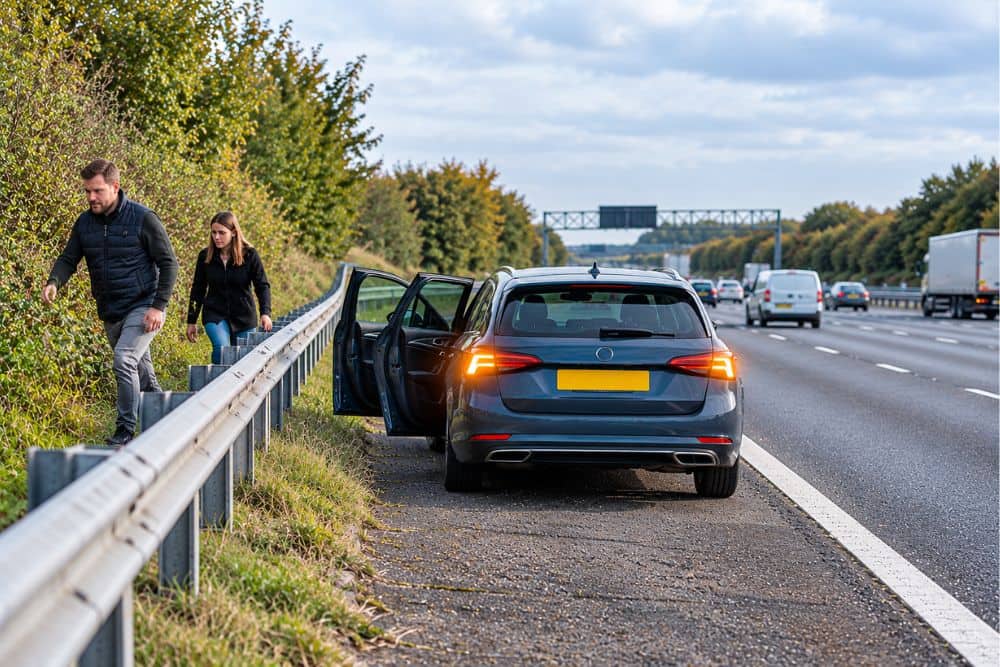
- Stand behind the barrier, well away from the carriageway.
- Keep every passenger beside you, not between the car and the traffic.
- Avoid the dark side of an embankment, where unseen hazards such as ditches and drops are common.
- Watch the traffic, not the car.
A person who feels threatened by a stranger returns to the car through the left-hand door, locks it and dials 999.
6. Use the Emergency Roadside Telephone to Request Help
An emergency roadside telephone is a free orange phone connected to the National Highways control centre in England. Scotland and Wales have their own operators.
- Follow the arrows on the marker posts to the nearest phone, which is about a mile away at most.
- Walk behind the barrier, never along the hard shoulder or carriageway.
- Face oncoming traffic while using the handset.
- Tell the operator the car’s problem and the passengers’ circumstances, such as a child or disability.
A mobile phone also works. Dial 999 if there is danger. Otherwise, call the breakdown provider. Road conditions, not signal strength, decide which of the two is quicker.
7. Contact Your Breakdown Provider With Your Exact Location
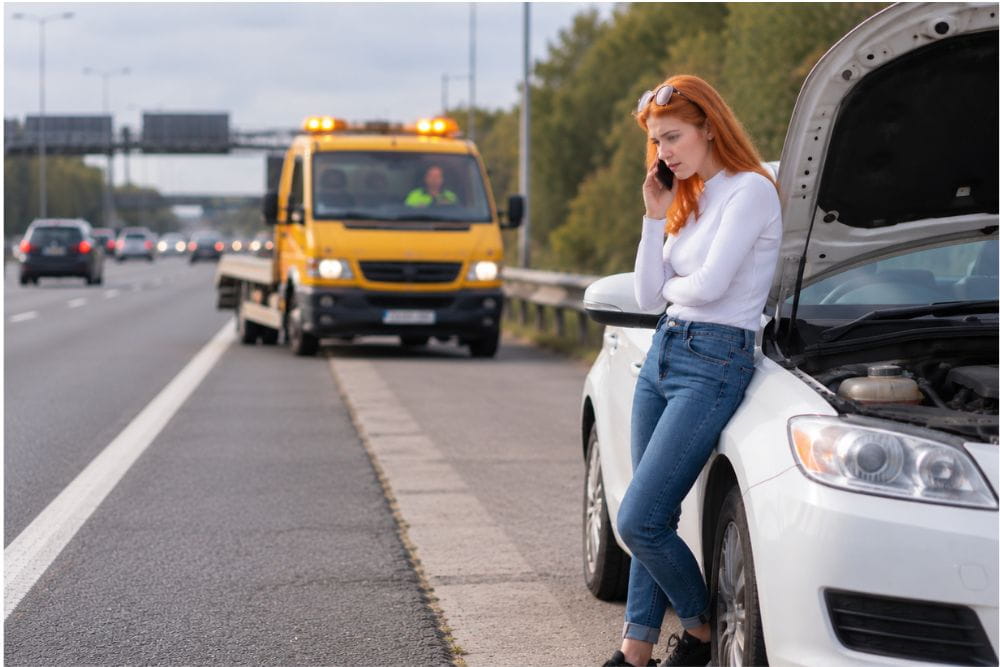
Breakdown providers locate a car from the motorway number, direction of travel and the nearest marker post or driver location sign. Marker posts stand every 100 metres. Driver location signs stand roughly every 500 metres and show the carriageway code and distance in kilometres.
Give the operator these five details:
Give the operator these five details:
- Motorway number and direction of travel
- Nearest junction
- Number and letter from the nearest marker post or location sign
- Registration number and car model
- Passengers who are children, elderly or disabled
A full location reads like this: “M6 northbound, between junctions 6 and 7, marker post 99.4.” Operators confirm the position against their map before dispatching.
What Should You Not Do During a Motorway Breakdown?
Do not place a warning triangle, attempt repairs or stand close to the carriageway. Each of these keeps you near fast-moving traffic.
- Do not place a warning triangle: Setting one up means walking onto the carriageway.
- Do not attempt repairs: Checking under the bonnet or changing a wheel keeps you beside moving vehicles.
- Do not use the traffic-side door: Exit through the left-hand door, furthest from the lanes.
- Do not stand beside or behind the car: A vehicle struck from behind can be pushed forward. Wait on the verge, behind the safety barrier.
- Do not get back into the car: Stay out of the vehicle unless you feel threatened. In that case, re-enter through the left-hand door and lock it.
- Do not let pets loose: Leave animals in the car where possible. If they must leave, keep them on a lead on the verge.
What Should You Do If the Car Stops in a Live Lane on a Motorway?
If your car stops in a live lane on a motorway, stay inside, keep the seat belt on and call 999. A live lane is any lane that carries moving traffic. National Highways advises stopping in one only when unavoidable.
- Switch on the hazard warning lights: Drivers behind see the stopped car sooner.
- Keep the seat belt fastened: Crossing live lanes on foot carries the greater danger.
- Dial 999 and ask for the police: Press the SOS button instead if the car has eCall.
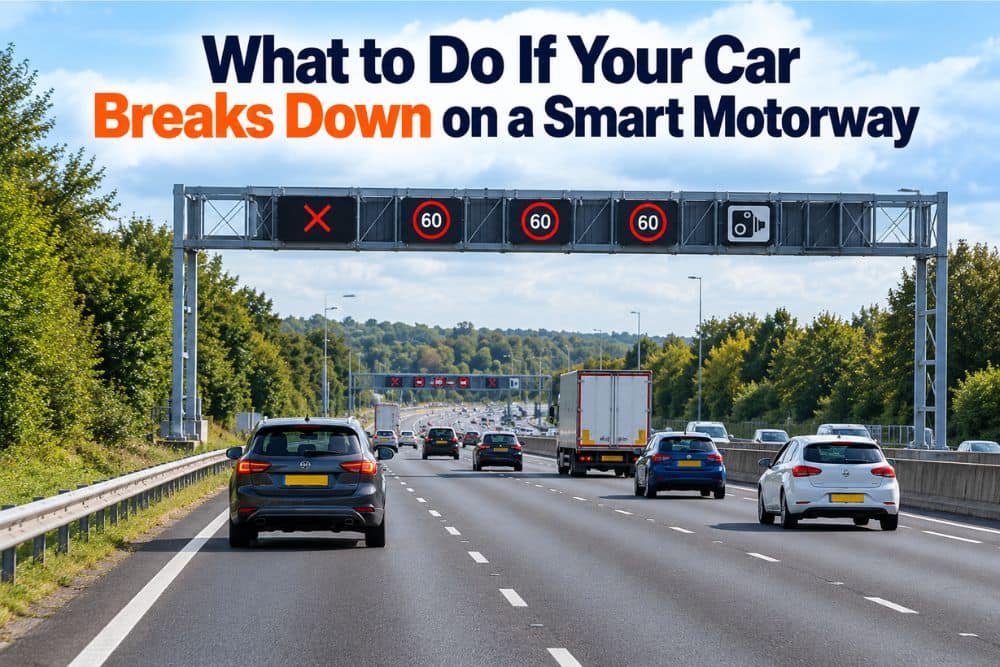
- Wait for the lane closure: The emergency services alert National Highways, which closes lanes (shown by a red X) and sends a traffic officer.
What Should You Do If the Car Breaks Down in Motorway Roadworks?
If your car breaks down inside motorway roadworks, drive on to the next exit or emergency area while the car still moves. Cones and barriers sit close to moving traffic.
- Move left: Use the left lane and stop only where no exit or emergency area is reachable.
- Switch on the hazard lights: Add sidelights in darkness or poor visibility.
- Call for help: Use the roadside phone or 999, and give the roadworks location and lane.
- Stay inside if exiting is unsafe: Keep the seat belt on and ask 999 for the police.
- Keep to the posted limit: Speed cameras stay active while the car coasts.
What Should You Do If a Tyre Blows Out on the Motorway?
If a tyre blows out on a motorway, grip the steering wheel with both hands, lift off the accelerator and let the car slow without hard braking. Then steer left to the hard shoulder or an emergency area.

- Grip firmly: Both hands counter the pull toward the flat side.
- Avoid the brake pedal: Hard braking unbalances the car and starts a skid.
- Hold a straight line: Make small, steady steering corrections.
- Signal left and stop: Hazard lights on, wheels turned left, handbrake applied.
- Leave by the left-hand doors: Wait behind the safety barrier.
- Call for help: Use the roadside phone or a mobile. Providers fit the spare or tow the car.
How Does Motorway Recovery Work After a Breakdown?
Motorway recovery moves a broken-down car from the carriageway to a place of safety. A breakdown provider sends the truck, and National Highways can close lanes and send a traffic officer.
- Vulnerable motorist flag: Face the traffic during the call, and tell the operator about any disability, older passenger or solo travel.
- Location check: The provider confirms the motorway, direction and marker post number with the caller.
- Scene protection: National Highways sets signs or closes lanes before loading starts.
- Assessment: The operator inspects the car and its position, then picks a fix or a tow.
- Loading: A flat-bed winches the whole car onto its deck. Electric cars and automatics rely on this method.
- Destination: Cover terms decide the drop-off: a nearby garage, home or a chosen address.
- Passengers: Cab seats are limited, so give the passenger count when booking.
- Genuine operator: A real operator arrives after a call the driver made, names the provider and quotes the booking reference.
How Does a Motorway Breakdown Differ for Electric Cars, Vans and Motorbikes?
Vehicle type changes the recovery method because weight, drivetrain and towing limits differ. This table compares the extra steps and the recovery method for each type.
| Vehicle | Extra step | Recovery method |
|---|---|---|
| Petrol or diesel car | None beyond the standard steps | Flat-bed or wheel-lift tow |
| Electric car | Report the battery warning and remaining range | Flat-bed. Most manufacturers specify it, and the handbook confirms it. |
| Van | Give the provider the van’s height, weight and load | Larger recovery truck for heavy or tall vans |
| Car with caravan or trailer | Tell the provider a trailer is attached | Specialist recovery. Not every policy covers trailers. |
| Motorbike | Pillion passenger waits with the rider behind the barrier. The DVSA publishes rider-specific breakdown guidance. | Dedicated carrier or ramp truck |
An electric car warns about low charge in stages, then limits power. Leave at the next exit or service area at the first range warning.
How Should You Rejoin the Motorway After a Breakdown?
To rejoin a motorway from the hard shoulder, build up speed along the shoulder before merging into lane one. The Highway Code gives no exact speed figure.
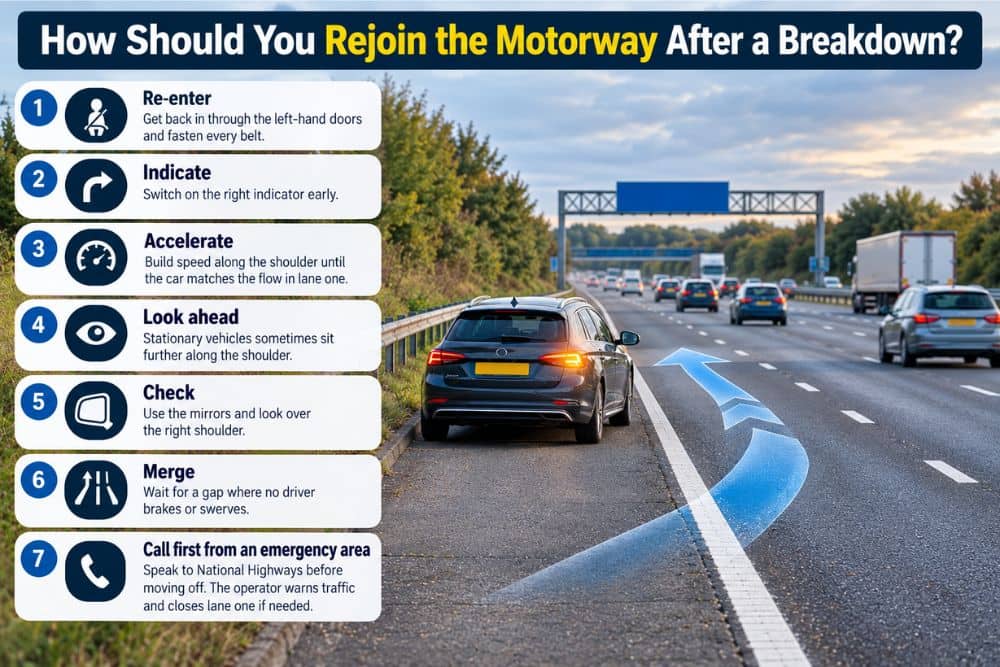
- Re-enter: Get back in through the left-hand doors and fasten every belt.
- Indicator: Switch on the right indicator early.
- Speed: Accelerate along the shoulder until the car matches the flow in lane one.
- Look ahead: Stationary vehicles sometimes sit further along the shoulder.
- Check: Use the mirrors, look over the right shoulder, then merge into a safe gap.
- Gap: Wait for a gap where no driver brakes or swerves. Do not rely on headlight flashes.
- Emergency refuge area: Speak to National Highways before moving off. The operator warns traffic and closes lane one if needed.
What Does Free Motorway Recovery Cover?
Free motorway recovery moves a stranded vehicle a short distance to a place of relative safety, such as the next slip road or service area. Roadworks schemes that offer it set their own limits. This table separates the free service from the chargeable work.
| Included | Not included |
|---|---|
| Clearing the car from live lanes | Towing to home or a repairer’s garage |
| Moving the car to a nearby safe spot | Roadside repairs such as a flat battery, puncture or engine fault |
| Reducing danger and congestion for other drivers | Onward recovery, which the driver arranges and pays for |
Which Car Warning Signs Mean Stopping Straight Away on the Motorway?
A red or amber dashboard warning means leaving the motorway at the next exit or service area where possible. If the car cannot reach one, the left lane, an emergency area or the hard shoulder is the next best place. This table links each warning to its likely cause and the next move.
| Warning | Likely cause | Action |
|---|---|---|
| Red oil pressure light | Low oil or pump failure | Leave at the nearest safe place. Engine damage follows quickly. |
| Red coolant temperature light | Overheating | Leave at the nearest safe place. Keep the bonnet shut. |
| Red brake warning | Low brake fluid or brake fault | Leave at the nearest safe place |
| Red battery or charging light | Alternator or battery fault | Exit as soon as possible. The car runs on stored charge only. |
| Flashing engine management light | Severe misfire | Slow down and leave at the next exit |
| Steady amber engine light | Sensor or emissions fault | Drive to the next exit and book a garage check |
| Tyre pressure warning | Slow puncture or sudden loss | Reduce speed. Leave at the next exit if steering feels normal. |
| Loss of power | Fuel, turbo or electrical failure | Hazards on. Coast toward the left lane, emergency area or hard shoulder. |
| Heavy steering or burning smell | Steering, brake or electrical fault | Leave at the nearest safe place |
Is It Legal to Stop or Leave a Car on a Motorway?
It is illegal to stop or leave a car on a motorway in the UK unless a breakdown, an emergency or a police or traffic officer instruction applies. Signs and signals also direct stops.
- Breakdown stops: Stopping on the hard shoulder or in a refuge area is permitted when the car breaks down.
- Routine stops: A phone call, a map check, a rest or a toilet break all count as prohibited stops.
- Red X signals: Driving in a lane under a red X breaks the law and carries a fixed penalty.
- Abandoned cars: A car left behind without arrangements is removed at the owner’s cost.
- Penalty amounts: Current fixed penalty figures sit on GOV.UK.
How Do You Prepare for a Motorway Breakdown Before the Journey?
To prepare for a potential motorway breakdown, check the car and pack a short kit before setting off. National Highways also lists planned breaks and avoiding tired driving as part of preparation.
- Roadworthiness: Check tyres (1.6mm legal minimum tread), fluids and lights.
- Fuel or charge: Start with enough for the whole route.
- Kit in the car: Warm clothes, a hi-vis jacket within reach, a torch and breakdown cover details.
- Long journeys: Add medication, a charged phone, food and water.
- Contacts: Save the breakdown provider and National Highways in the phone.
- Breaks: Plan rest stops along the route.
- Hidden disability: A free Sunflower for the vehicle alerts traffic officers to a non-visible disability.
What Do Drivers Ask Most About a Motorway Breakdown?
Drivers most often ask about helping others, walking to an exit, lifts from strangers and disability.
- Can a friend or passer-by stop to help? No. Stopping to assist is unsafe. Call National Highways, or 999 if life is at immediate risk.
- Can you walk to the next exit? No. Walking along the hard shoulder or carriageway is prohibited.
- Can you accept a lift from a passing driver? No. A lift takes you out of reach of the control room, and nobody knows where you went.
- What if a disability prevents the standard steps? Stay inside with the hazard lights and seat belt on, then call 999 and ask for the police.
Last Thoughts
A motorway breakdown is manageable when you act in the right order. Leave at the next exit if the car steers normally, otherwise stop on the hard shoulder or in a refuge area. Exit through the left-hand doors, wait behind the barrier and give the operator your exact location. Never place a triangle, attempt repairs or accept a lift. Save your breakdown provider’s number and National Highways’ contact details before every journey.
Frequently Asked Questions
Can you use a mobile phone after a motorway breakdown?
Yes. Use a mobile once you stand behind the safety barrier. Call the breakdown provider first, or 999 if you are in danger. A mapping app confirms your position, but marker posts and driver location signs give operators the most accurate reference.
Should you call the police after a motorway breakdown?
Call 999 only if you are in danger, feel threatened, cannot leave the car or are stopped in a live lane. For a breakdown on the hard shoulder, call your breakdown provider or National Highways instead. A traffic officer attends if required.
What if the car does not fit fully onto the hard shoulder?
Stop as far left as possible, turn the wheels left and switch on the hazard lights. Leave through the left-hand doors only if you can reach the barrier safely. Otherwise, stay belted inside and call 999 immediately. The police then arrange a lane closure.
Which way do you walk to the nearest emergency telephone?
Follow the arrows on the marker posts, which point to the nearest telephone. Walk behind the barrier, never along the hard shoulder. The nearest phone sits about a mile away at most. Face oncoming traffic while speaking to the operator.
What should you do on a motorway with no hard shoulder?
Head for an emergency refuge area, marked by an orange surface and a blue SOS sign. If the car stops in a live lane and no refuge area is reachable, keep the seat belt on, switch on the hazard lights and call 999.
Do you need breakdown cover to drive on a motorway?
No law requires it, but cover is strongly advisable. Without it, you pay for recovery yourself, and the bill runs high on a motorway. Check that the policy includes roadside assistance, onward recovery and any trailer you tow, because not every policy covers trailers.
What happens if you run out of fuel on a motorway?
Out-of-fuel stops count as preventable breakdowns. Follow the standard steps: hard shoulder, hazard lights, left-hand doors, behind the barrier. You are usually responsible for the recovery costs. Stop at a service area before the fuel warning appears. Electric cars follow the same rule for charge.
What should you do if your car breaks down in a tunnel?
Switch on the hazard lights, turn off the engine and leave the vehicle if it is safe. Use the emergency telephone in the tunnel to alert the control room, rather than a mobile. Follow signs to the nearest exit. Operators then close lanes and send help.
How do you report someone else’s broken-down car on a motorway?
Do not stop to look. A passenger or a driver at a service area reports it to National Highways, or to 999 if the car blocks a live lane or anyone looks at risk. Give the motorway number, direction and nearest marker post.