A car breakdown stops a vehicle through a mechanical, electrical or structural failure, or a problem such as a flat tyre, flat battery or empty fuel tank, and it makes driving impossible or unsafe. Breakdowns split into service types, such as roadside assistance and recovery, and mechanical types, such as battery, tyre, engine and fuel faults. After one, the driver moves to a place of relative safety, switches on the hazard lights, exits away from traffic, calls for help and leaves repairs alone. The response shifts on motorways, smart motorways, at night and with children or pets on board.
Seasonal checks on the battery, tyres, coolant and fluids follow National Highways’ T.R.I.P. checklist: top up, rest, inspect and prepare. A flat or failing 12-volt battery is the most common cause in breakdown-provider call-out data, and tyre issues lead on National Highways roads. A reliable provider confirms the price before dispatch, holds transit insurance and sends a matched truck. Electric cars, motorbikes and vans differ mainly in recovery method. A quick vehicle check, a stocked kit and saved contacts prepare drivers before a journey.
Table of Contents
ToggleWhat Is a Car Breakdown?
A car breakdown happens when a vehicle stops working because of a mechanical, electrical or structural failure, or an issue such as a flat tyre, flat battery, empty fuel tank or lost keys. The failure makes driving impossible or unsafe. Severity decides the fix: serious faults call for a tow to a garage, while smaller ones get repaired on-site by roadside assistance or a mobile mechanic.
Some faults let the car run normally for a while but still need repair later. Drivers who delay maintenance because of cost or a busy schedule raise the chance of a breakdown, further damage and added danger.

How Many Types of Car Breakdowns Are There in Birmingham?
Car breakdowns in Birmingham fall into two groups containing ten types: four service types, which describe how help is delivered, and six mechanical types, which describe the fault. Busy routes such as the M6, M5, M42 and A38 produce both.
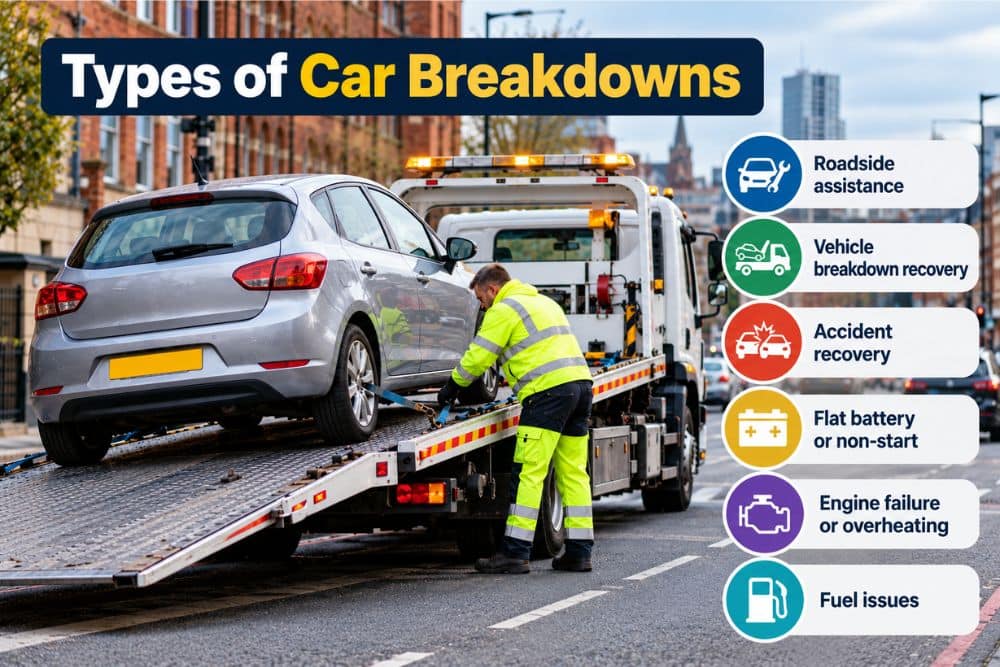
Service Types
- Roadside assistance: A mobile mechanic repairs a minor fault on the spot, and the driver continues the journey.
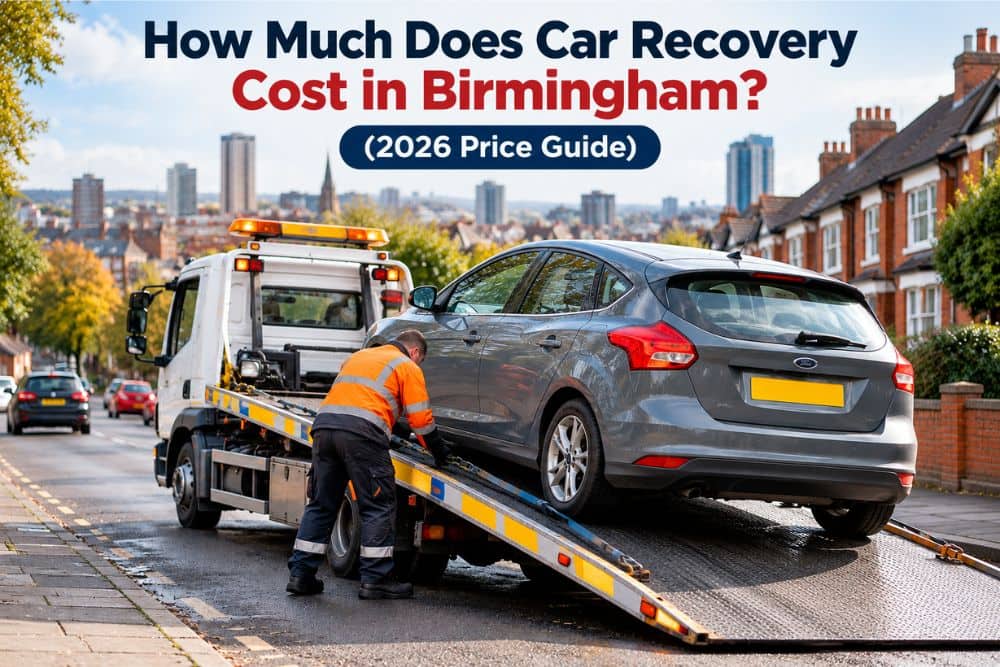
- Vehicle breakdown recovery: A flatbed or tow truck moves a car that cannot be repaired at the roadside to a home address or local garage.
- Accident recovery: Specialist equipment moves a vehicle damaged in a collision, and this service is usually separate from mechanical breakdown policies.
- Specialist extraction: Recovery crews retrieve vehicles stuck in a ditch, mud or a multi-storey car park where standard trucks cannot reach.
Mechanical Types
- Flat battery or non-start: Faulty alternators, ageing batteries and drained power stop the engine from turning over.
- Flat or punctured tyre: Potholes, kerbs and debris on city roads and motorways damage tyres and rims.
- Engine failure or overheating: Coolant leaks, blown head gaskets and failing thermostats trigger warning lights, particularly in standstill traffic.
- Clutch and gearbox faults: Stop-start congestion around the city centre and ring roads strains clutches, causing slipping or failure to change gear.
- Fuel issues: Running out of fuel and misfuelling, such as petrol in a diesel car, need roadside draining before the engine starts.
- Warning lights and electrical faults: Sudden power loss and sensor or computer failures stop the car.
What to Do After a Car Breakdown?
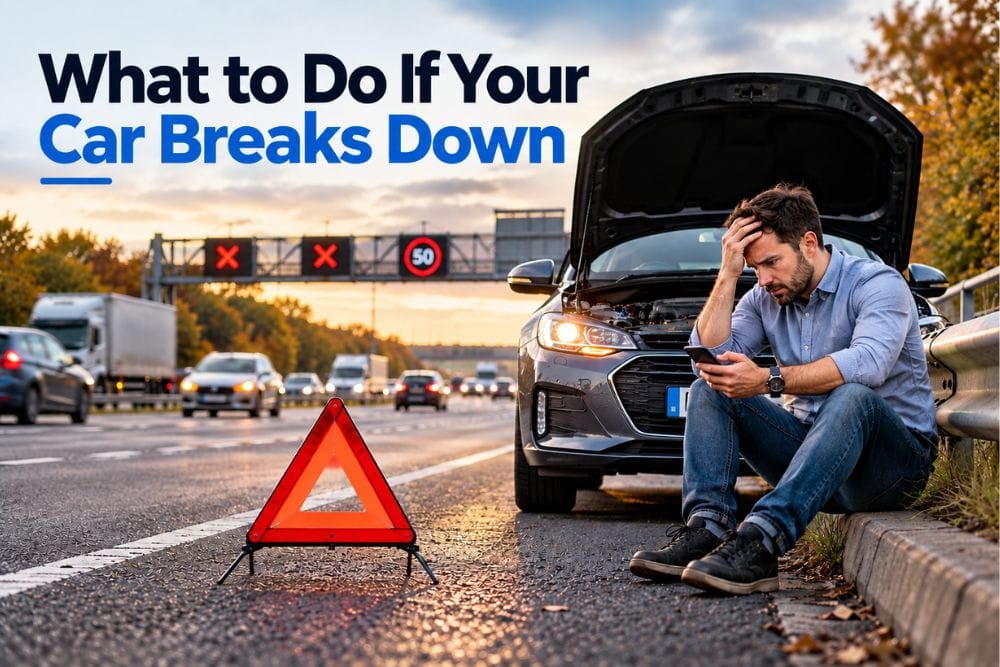
After a car breakdown, six steps come first: moving to a place of relative safety, switching on the hazard lights, exiting away from traffic, waiting behind a barrier, calling for help and leaving repairs alone. Rules 275 to 278 of the Highway Code set out the sequence.
- Move to a place of relative safety: The Highway Code names a service area as the safest stop on a motorway. Lay-bys, emergency areas and hard shoulders also count as places of relative safety, but hard shoulders give less protection because traffic passes close by.
- Switch on the hazard lights: Hazard lights warn traffic about the obstruction, and the Highway Code directs drivers to use them on a motorway. Sidelights add visibility in the dark or in poor visibility.
- Exit away from traffic: Drivers leave by the side furthest from traffic, which is the left-hand side on a motorway, only when exiting is safe. Passengers follow the driver out.
- Wait behind the barrier: On a motorway, everyone waits behind the safety barrier where one exists, away from the carriageway and clear of any spot where passing traffic could push the vehicle into them. Animals stay in the vehicle, and children stay under adult control.
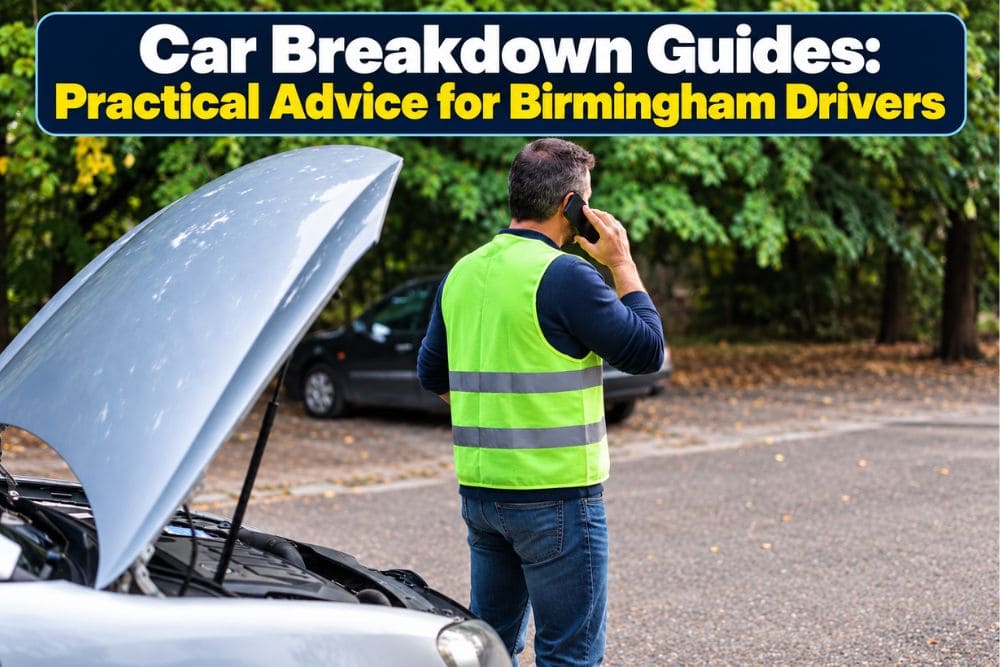
- Call for help: The free emergency telephone connects directly to a National Highways regional operations centre and identifies the caller’s location. A mobile phone reaches a recovery operator, who asks for the number on the nearest marker post or driver location sign.
- Leave repairs alone: The Highway Code lists attempting repairs among the actions to avoid on a motorway. A mechanic or recovery operator carries out the repair.
On ordinary roads, a warning triangle goes at least 45 metres behind the vehicle on the same side of the road. The Highway Code excludes motorways from triangle use, and light-coloured or reflective clothing improves visibility on any road.
How Does a Car Breakdown Response Differ by Situation?
A car breakdown response differs by situation because location and conditions change where the driver stops, where passengers wait and which number the driver calls. Motorways, smart motorways, darkness and passengers each alter the steps. The list below gives the response for each case.
- Car Breaks Down on the Motorway: The driver leaves at the next exit or service area where possible. Otherwise, the car moves into the left lane and stops as far left as possible with the wheels turned left and the hazard lights on, ideally just beyond an emergency telephone.
- Car Breaks Down on a Smart Motorway: The driver heads for an emergency area, painted orange and marked by a blue sign with an orange SOS telephone symbol. The driver speaks to National Highways before leaving the emergency area. If no emergency area is reachable, the driver stays belted inside with the hazard lights on and calls 999.
- Car Breaks Down at Night: The driver wears reflective clothing, keeps sidelights on and stands clear of any position that hides the vehicle’s lights. On a motorway, a driver who has exited does not return to the vehicle, even in rain, cold or darkness. A lone traveller tells the operator at the start of the call.
- Car Breaks Down With Children or Pets: Adults keep children under control and away from the carriageway. Animals stay in the vehicle or, in an emergency, under control on the verge, because a frightened pet can run into traffic. Callers report an animal left inside, particularly in hot weather.
How to Avoid Seasonal Car Breakdowns?
To avoid seasonal car breakdowns, match each check to the season: battery and antifreeze in winter, suspension and tyres in spring, coolant and tyre pressure in summer, lights and wipers in autumn. National Highways recorded 71,254 breakdowns on England’s motorways and major A roads in spring 2025, which is 25.6% more than in spring 2022. National Highways promotes a four-step T.R.I.P. checklist: top up fuel, oil and screenwash, rest every two hours, inspect tyre pressure and tread, and prepare a plan for severe weather.
The list below gives the checks for each season and for floodwater.
- Winter: Check the battery, antifreeze and tyre tread before frost arrives. National Highways names tyre issues and loss of power as the main winter causes. Cold cuts battery output. Stopping distances rise sharply once tread falls below 3 mm.
- Spring: Check tyres, wheels and suspension for winter damage. Frost and thaw widen potholes, and a pull to one side or a dented rim signals a problem. Tyre issues top the causes of February and March breakdowns, according to National Highways analysis.
- Summer: Check coolant, oil and tyre pressure before long journeys. Measure pressure when the tyres are cold, because it rises as they heat up. National Highways recorded 1,974 tyre-related breakdowns in the West Midlands between June and August 2022.
- Autumn: Check lights, wipers and battery before the clocks go back at the end of October. Wet leaves reduce tyre grip, and Rule 226 of the Highway Code requires headlights once visibility falls to about 100 metres.
- Floodwater: Keep the engine switched off after a stall. Restarting draws water into the cylinders, called hydrolock, which bends connecting rods and damages pistons. Environment Agency research found that 30 cm of moving water is enough to float a car.
What Is the Most Common Cause of Car Breakdown?
The most common cause of car breakdown in breakdown-provider call-out data is a flat or failing 12-volt battery. National Highways ranks tyre issues first on motorways and major A roads, with 16,943 tyre breakdowns (18.6%) in winter 2023/24. Loss of power (6,572; 7.2%), engine faults (2,918), running out of fuel (2,263) and clutch or gear faults (1,985) follow.
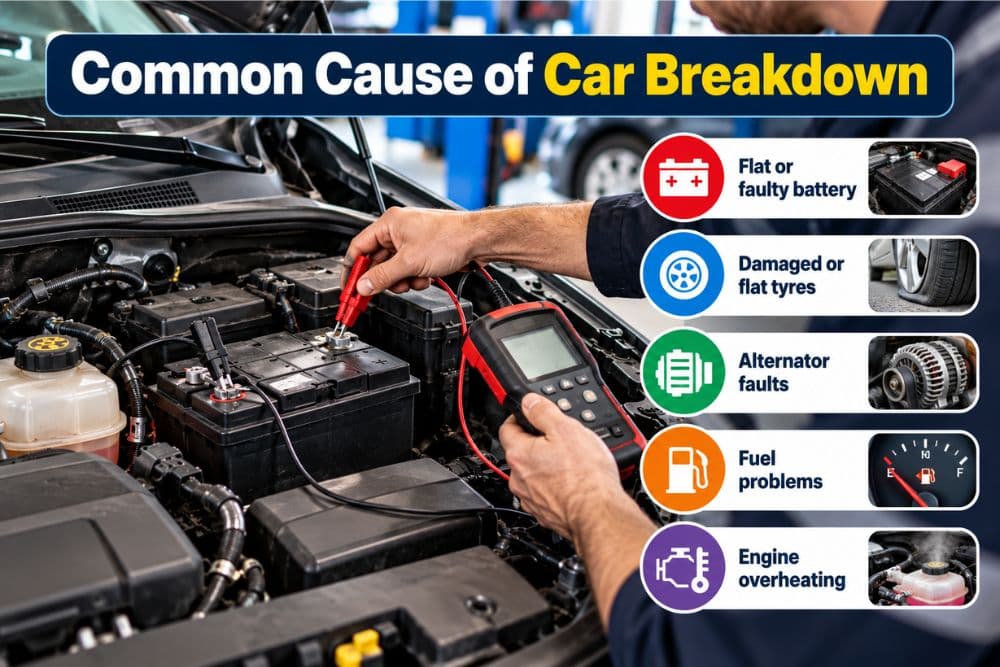
- Flat or faulty battery: Cold weather, an age beyond the typical three to five years of battery life, lights left on and short journeys that give the alternator too little time to recharge cause failure.
- Damaged or flat tyres: Punctures from road debris, impacts with potholes or kerbs, and driving on under- or over-inflated tyres are the main causes of failure. Slow valve leaks add to the total.
- Alternator faults: A failed alternator stops charging the battery, which leads to dim lights and dashboard warnings. The battery drains until the engine cuts out.
- Electrical faults: Starter motor, ignition coil, fuse and electronic control unit failures prevent starting or cut power. Body control module faults have entered the top five call-out causes in breakdown-provider data, with incorrectly attached jump leads among the common triggers.
- Fuel problems: Running out of fuel and misfuelling, such as petrol in a diesel car, strand drivers. National Highways recorded 2,263 fuel-shortage breakdowns in winter 2023/24.
Is Car Breakdown Cover Worth It?
Car breakdown cover suits drivers on longer journeys and with older vehicles, while pay-as-you-go recovery suits drivers who travel short distances and rarely break down. UK motoring guides describe cover as optional and most useful on longer journeys and with older vehicles. A National Highways survey found that 53% of people nationally have broken down on a motorway or major A road in their lifetime. Recovery prices depend on distance, vehicle type, time of day and road conditions. Policies differ on nationwide recovery, home start and onward travel.
The table below compares three ways to pay for breakdown help.
| Option | How payment works | Typical user | Main limit |
|---|---|---|---|
| Annual breakdown cover | Yearly or monthly membership fee | Daily commuters and long-distance drivers | Exclusions and call-out limits apply |
| Pay-as-you-go recovery | One payment per recovery | Occasional drivers | Price depends on distance, time and vehicle type at the moment of the call |
| Bundled cover | Included with a bank account, warranty or insurance add-on | Drivers who already hold the qualifying product | Cover level and recovery distance vary by provider |
Each option trades fixed cost against cost per call-out. Three policy details decide what cover pays for:
- Cover level: Roadside assistance, recovery, home start and onward travel are the common levels. Each level adds a service and raises the price, so vehicle age and mileage guide the choice.
- Bundled cover: Manufacturer, bank and insurer bundles include cover as an extra, so the policy document confirms the level and recovery distance before the driver relies on it.
- Exclusions: The policy document lists exclusions, which commonly include repeat call-outs for the same fault, pre-existing faults, vehicle modifications, age caps, commercial use, annual call-out limits and waiting periods.
Reading these three entries before buying avoids surprises at the roadside.
How Do You Choose a Reliable Car Breakdown Recovery Service Provider?
A reliable car breakdown recovery service provider confirms the total price before dispatch, holds insurance for vehicles in transit, sends a truck matched to the vehicle, and answers calls 24 hours a day. Each detail is checkable during the first phone call.
- Provider types: National providers run large patrol networks. Independent and budget providers often price lower but vary in patrol coverage and call-out limits.
- Price confirmation: A reliable operator confirms the total price, including mileage, before dispatch. A clear answer on arrival time, drop-off location and payment method signals a transparent operator.
- Insurance in transit: A reliable operator holds insurance for vehicles in transit, which protects the vehicle during loading and towing. Confirmation of that cover is checkable during the first phone call.
- Matched truck: A reliable operator sends a truck matched to the vehicle. Flatbeds suit automatics, four-wheel-drive vehicles and low-slung cars, because rolling driven wheels risk damage.
- Availability: A reliable operator answers calls 24 hours a day, including nights, weekends and bank holidays, and gives an arrival estimate at dispatch. Estimates vary with distance, traffic and weather.
Do Electric Cars, Motorbikes and Vans Break Down Differently?
Yes, electric cars, motorbikes and vans break down differently from one another, mainly in recovery method rather than cause. Electric cars have no engine or clutch, but tyres, wheels and the 12-volt battery still lead call-outs, the same faults that lead to petrol and diesel breakdowns. Vehicle build and use set the remaining differences.
- Electric car breaks down: Running out of charge made up 1.85% of electric car call-outs in 2024, down from 2.26% in 2023. Recovery uses a flatbed with all wheels off the road, because rolling wheels generate electricity and overload a drivetrain never designed to receive it.
- Motorbike breaks down: Common faults include flat batteries, chain or drive-belt failures, clutch cable faults and punctures. A ramp or bike carrier with soft straps and wheel chocks secures the frame during recovery.
- Van breaks down: Heavy loads accelerate tyre, suspension and brake wear. Laden weight, height and cargo security decide the recovery truck, so operators ask about the load.
How Can You Prepare for a Car Breakdown Before a Journey?
Preparing for a car breakdown before a journey takes three actions: a five-minute vehicle check, a stocked breakdown kit and saved contact details. The check covers fluids, tyres, battery and lights, and the kit covers visibility, warmth and phone power. National Highways lists breakdown cover details, a charged phone and a route planner as essentials.
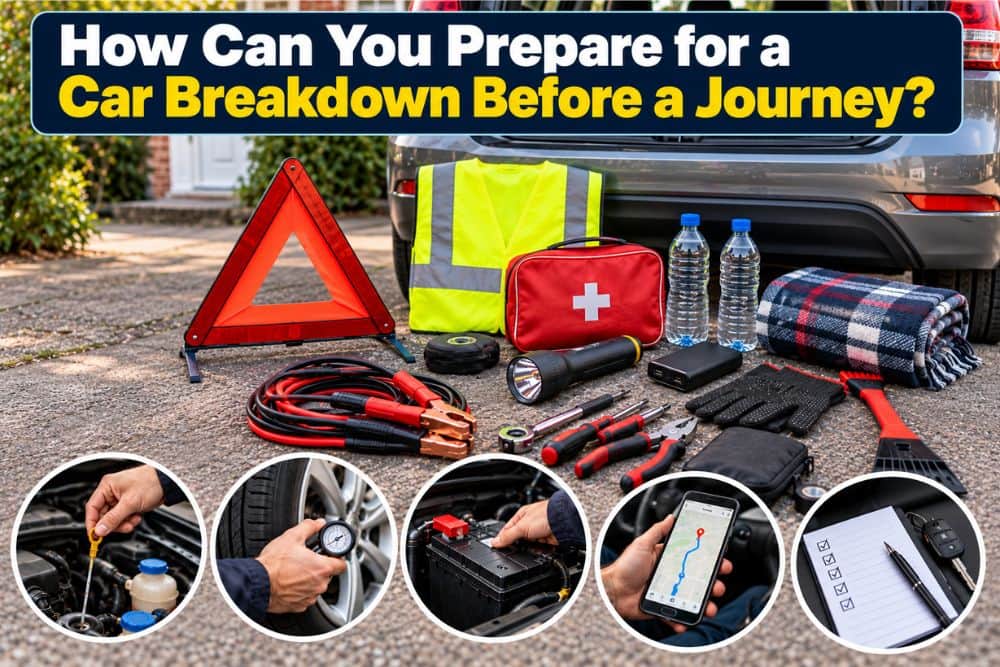
- Fluids and lights: Oil, coolant, brake fluid and screenwash levels, plus all lights and wipers, make up the pre-journey check. A warning light that stays on after the engine starts signals a fault.
- Tyres: Checks cover pressure, tread depth and sidewalls. The legal minimum tread depth is 1.6 mm, and a cut over 25 mm or 10% of section width, whichever is greater, reaching the ply or cord, makes a tyre illegal.
- Battery: Battery checks cover terminal corrosion and age against the typical three to five years of life. A charged battery and clean connections reduce the chance of a non-start.
- Visibility and warmth: The Highway Code advises light-coloured or fluorescent clothing in daylight and reflective clothing at night, so a high-visibility jacket for each passenger covers both. Warm clothing, a blanket, water and snacks cover a long wait.
- Kit tools: A torch, a first aid kit, a power bank for the phone and a warning triangle for non-motorway roads complete the kit. Winter adds a de-icer, ice scraper and shovel.
- Kit storage: Storing the kit within reach of the driver’s seat avoids opening the boot beside moving traffic. Insurance details and the breakdown cover app or card travel in the car too.
- Contacts and essentials: Saved contacts include the breakdown provider’s app or number. A mobile mapping app, or the numbers on a marker post or driver location sign, identifies a location on a motorway. A charged phone and a route planner finish the list.
Need Recovery in Birmingham or the West Midlands Right Now?
Vehicle recovery across Birmingham and the West Midlands runs 24 hours a day, including weekends and bank holidays. Local operators cover the main routes around the conurbation: the M6 at Gravelly Hill Interchange (Spaghetti Junction), the M5, the M42 and the A38. To get a truck moving, call or send a message with your location, vehicle type and fault. A reliable operator confirms the total price before dispatch. Services include breakdown recovery, roadside assistance, jump starts, fuel assistance and towing.
Frequently Asked Questions
Q: Is Pay-As-You-Go Recovery Cheaper Than Cover?
A: Pay-as-you-go recovery costs one fee per call-out, while breakdown cover costs a fixed membership fee. A driver with no call-outs in a year pays nothing under pay-as-you-go, while the membership fee is paid regardless. A driver with several call-outs reverses that comparison.
Q: Is It Safe to Stay in the Car After a Motorway Breakdown?
A: Staying in the car is the exception. The Highway Code directs drivers to leave by the side furthest from traffic and wait behind the barrier. When exiting is unsafe, the driver stays belted with the hazard lights on and calls 999.
Q: What Details Does a Recovery Operator Ask For?
A: Operators ask for the road, direction of travel, nearest junction or marker post, vehicle make, model and registration, fuel type, symptoms and passenger numbers. Gearbox type and power source matter, because automatic and electric vehicles travel on a flatbed. Vulnerable drivers say so at the start of the call.
Q: How Much Does Vehicle Recovery Cost?
A: Vehicle recovery cost depends on distance, vehicle type and size, time of day, road conditions and the nature of the incident. Long-distance jobs add mileage charges. A quote over the phone needs the pickup point, the drop-off address and the vehicle type.
Q: What Happens If You Break Down With No Cover?
A: Drivers without cover buy help at the roadside. Pay-as-you-go operators quote a one-off price once the caller gives the location, vehicle type and fault. Some national providers also sell cover to drivers who have already broken down.