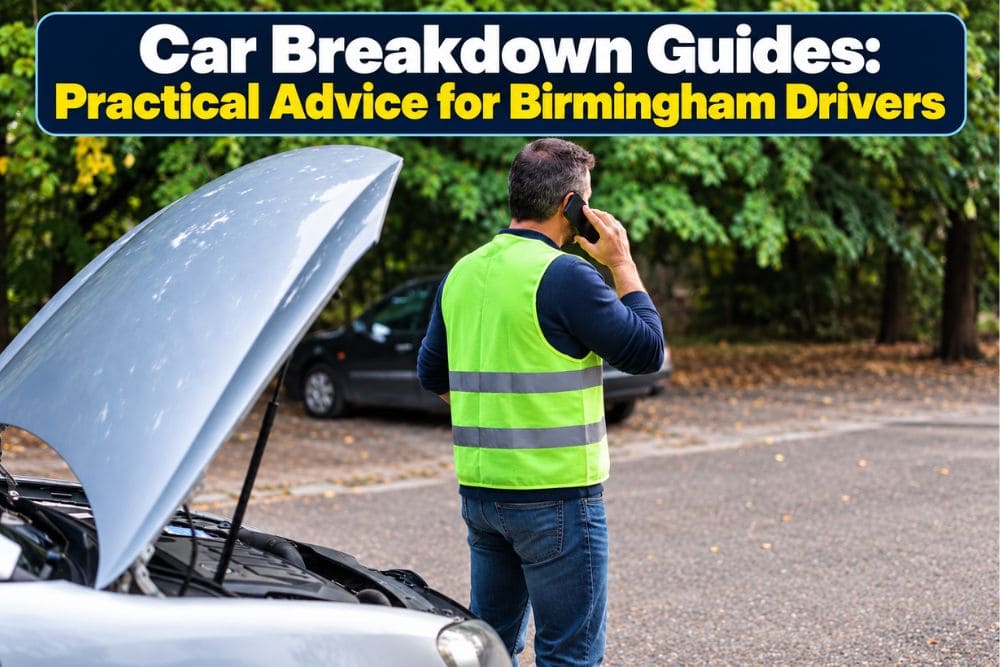
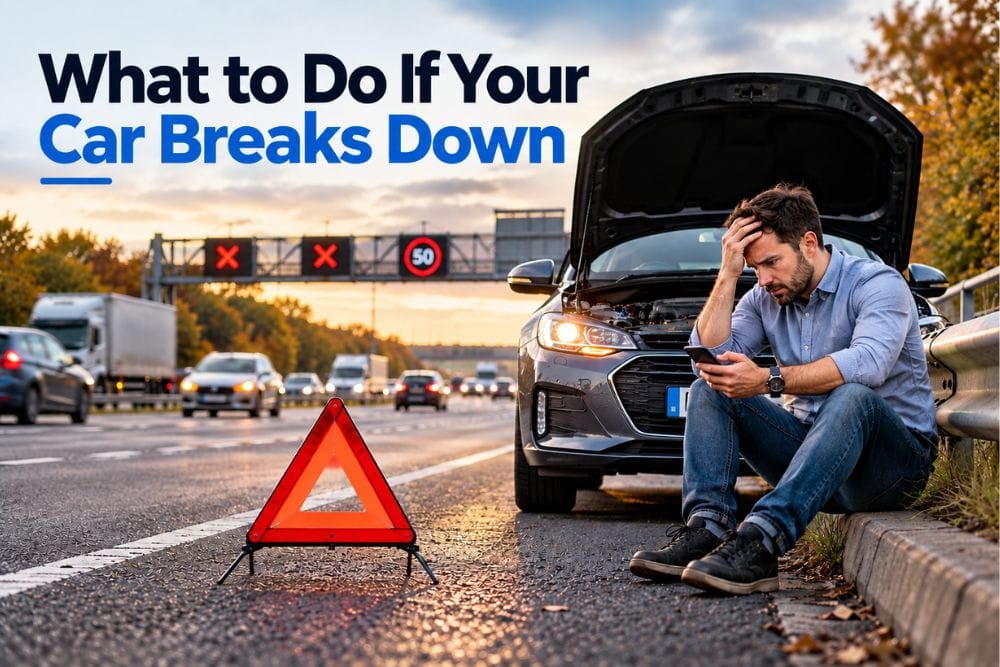
A car breakdown is an unplanned roadside stop caused by a mechanical, electrical or fuel fault, and the response it demands follows a fixed sequence. Hazard lights come on first, then a safe stop on a motorway, smart motorway, dual carriageway or country lane, followed by a clear read on whether the incident is a breakdown or a crash. The choice between 999, a breakdown provider, a garage or 101 depends on location, not on cover status, and applies equally on a roundabout, in a city centre or at home.
A flat battery often resolves with a jump start rather than a full recovery callout. Cost without cover, buying cover after the event, and electric or hybrid faults each carry their own rules. Securing an unattended car, a few overlooked safety habits, lease and Motability arrangements, a proper emergency kit, what happens once recovery arrives, insurance implications and basic prevention complete the picture.
Quick checklist: the first 60 seconds
This is the order that applies regardless of road type. Sections below cover what changes on a motorway, smart motorway or minor road.
1
Hazard lights on immediately, before the car has fully stopped
2
Steer left, slow down gradually, avoid sudden braking
3
Get off the carriageway if possible: hard shoulder, lay-by, verge or nearest exit
4
Turn the steering wheel fully left once stopped
5
Exit by the door furthest from traffic; passengers do the same
6
Move behind a barrier or well away from the car if it’s safe to do so
7
Call 999 if stopped in a live lane or anyone is in danger; otherwise call your breakdown provider or a garage.
Table of Contents
ToggleWhat should I do the first moment my car breaks down?
Switch on the hazard lights as soon as a fault appears, before the car has even stopped. This warns other drivers immediately, rather than after the vehicle is already stationary.
Steer left and reduce speed gradually. Sudden braking increases the risk of being hit from behind. Aim for a lay-by, service area or the hard shoulder if one is available; failing that, get as far onto the verge or left-hand side of the road as the surface allows.
Once stopped, turn the steering wheel fully to the left. This means that if the car is struck from behind, it moves further away from traffic rather than into it.
Leave the vehicle by the door furthest from moving traffic, normally the left-hand or passenger-side door. Passengers exit the same way. Anyone with a hi-vis jacket in the car puts it on before stepping out.
Pets are generally safer left inside the car with a window cracked slightly for ventilation, rather than let out near moving traffic; the exception is a live-lane motorway stop, where the advice is to stay inside with the pet and call 999 rather than exit at all.
Is this a breakdown or a crash?
A breakdown is a mechanical or electrical stoppage with no collision involved; a crash involves impact with another vehicle, object or person. The safety steps overlap- hazard lights, moving to safety, calling for help, but a crash carries extra legal duties.
Stopping after any collision is a legal requirement, and the police must be informed if the road is blocked or anyone is injured. If a breakdown has been caused by hitting something, such as a pothole or debris, treat it as a collision for reporting purposes even if no other vehicle was involved. Where a breakdown escalates into a collision, for example, being struck while stationary, both sets of obligations apply.
What do I do if I break down on a motorway?
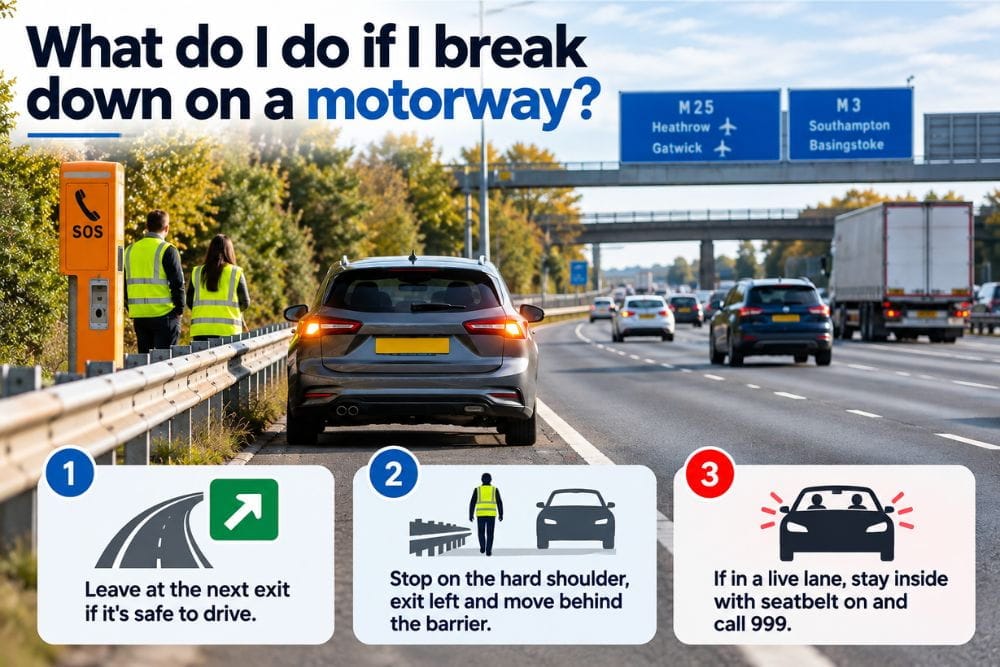
Leave at the next exit or pull into a service area if the car can still be driven safely. If it cannot, move onto the hard shoulder and stop as far left as possible, ideally near one of the emergency roadside telephones spaced at roughly one-mile intervals.
Exit through the left-hand door and move behind the safety barrier, well clear of the carriageway. A warning triangle is not used on a motorway hard shoulder; walking back to place one puts a driver directly in the path of traffic travelling at speed. For situations this section doesn’t cover, such as breaking down at night, running out of fuel, or dealing with an accident, this motorway breakdown guide has the details.
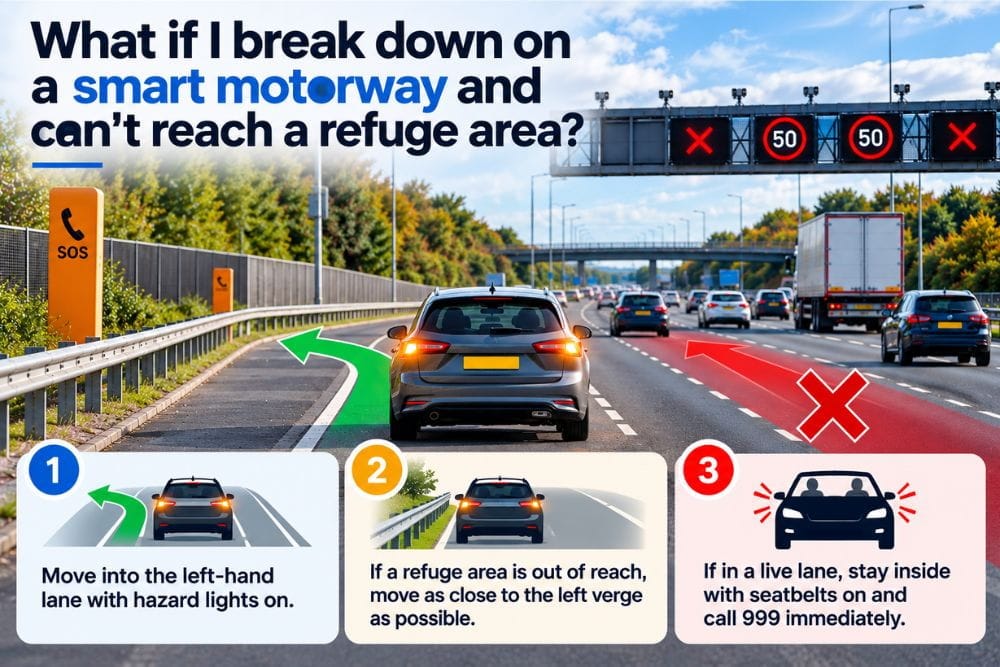
If the car cannot reach the hard shoulder and stops in a live lane, stay inside with the seatbelt fastened and hazard lights on, and call 999 immediately. This is the one motorway scenario where staying in the vehicle is the safer option.
What if I break down on a smart motorway and can’t reach a refuge area?
A smart motorway removes the continuous hard shoulder and uses variable speed limits and Emergency Refuge Areas (ERAs) instead, marked by orange SOS signs roughly 1.5 miles apart. The first action is to move into the left-hand lane with hazard lights on and aim for the next ERA, junction or service area.
If an ERA is out of reach, move the vehicle as close to the left verge or boundary as the road allows. Exit via the left-hand door only if this can be done clear of moving traffic, and wait behind a barrier if one exists.
If the car stops in a live lane away from the verge, stay inside with seatbelts and hazard lights on and call 999 straight away. National Highways can close the lane remotely once alerted, which is not possible until the incident is reported.
What do I do if I break down on a dual carriageway, A-road or country lane?
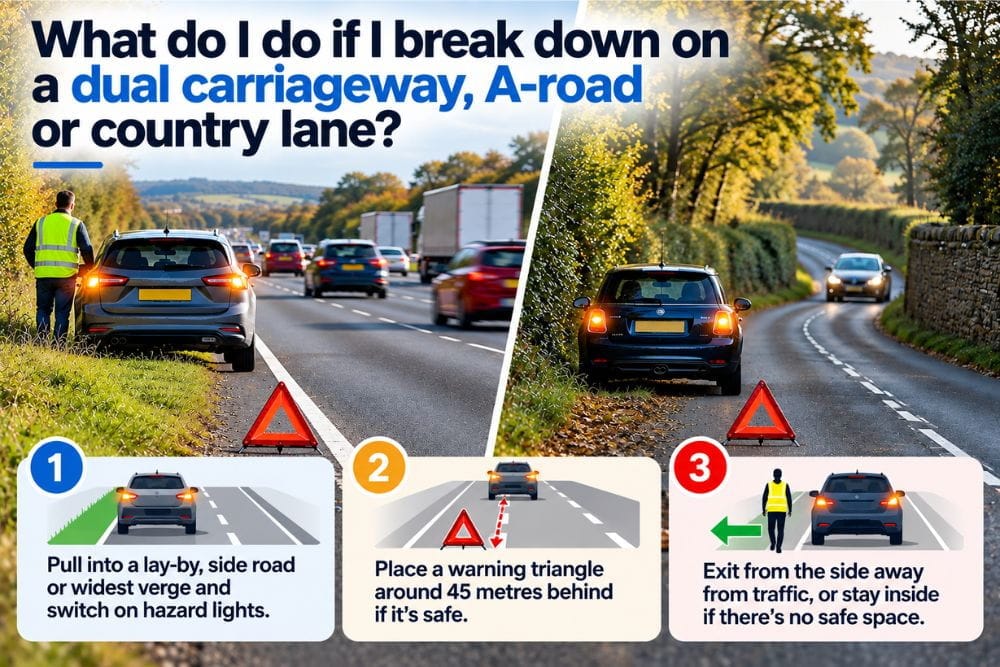
Pull into a lay-by, side road or the widest available verge, then switch on hazard lights. On a dual carriageway, treat the situation with motorway-level caution given the higher traffic speed; on a narrower country lane, a lower speed limit reduces the risk but visibility around bends is often worse.
Place a warning triangle around 45 metres behind the vehicle if it is safe to walk there and the road is not a motorway. On a bend, position the triangle before the bend so approaching traffic has time to react.
Exit the vehicle from the side away from the road wherever there is space to do so. On a narrow country lane with no verge, staying inside with hazards on is sometimes the safer choice than opening a door into the carriageway; the decision depends on how much clearance exists at that specific spot.
What if I break down on a roundabout, in a city centre, or at home?
On a roundabout, move to an exit if the car can still roll, or stop as close to the left as possible away from other exiting traffic. Switch on hazard lights, then move away from the vehicle to call for assistance rather than standing beside it.
In a city centre, aim to clear the road into a parking space or side street if the car has enough power to coast there. Turning hazards on and calling the breakdown provider from a position away from moving traffic reduces disruption to other drivers and lowers personal risk.
At home, on a driveway or private road, there is no obstruction risk, so the priority shifts to diagnosis and cost. Some breakdown policies include “home start” cover for faults like a flat battery; without it, a local garage or mobile mechanic is usually cheaper than a full recovery callout.
What if I get a flat tyre?
A flat tyre is one of the few faults safe to fix roadside, provided the car is off the carriageway on level ground.
Check that a spare wheel, or a sealant-and-inflator kit, is actually present before starting; some newer cars carry only a repair kit rather than a full spare. Loosen the wheel nuts slightly before jacking the car up, not after, since the wheel will spin once it’s off the ground. Once the flat is off, hand-tighten the replacement in a star pattern, then lower the car and fully tighten the nuts with the car’s weight back on the ground.
A tyre that has blown out rather than simply deflated, or shows a sidewall bulge or tear, is not safe to change at the roadside on a motorway hard shoulder. Call a breakdown provider instead; the risk of working that close to live traffic outweighs the time saved.
What if my car is overheating?
Steam or a strong smell from under the bonnet means the engine needs to stop and cool, not be driven further. Pull over as soon as it’s safe, switch off the engine, and open the bonnet from inside the cabin if the release allows it.
Leave the engine for at least 30 minutes before touching anything under the bonnet. Never remove the radiator or expansion tank cap while the system is still hot; it’s pressurised, and opening it too early can cause a sudden release of scalding steam. Once cooled, open the cap slowly with a cloth over your hand, and check the coolant level. If it’s low, top up with coolant or, in an emergency, water mixed with coolant, then drive to a garage rather than continuing the original journey.
An engine that overheats a second time on the same trip indicates a leak or a failed component, not a one-off low fluid level, and needs a garage before it’s driven again.
How do I jump-start a car with a flat battery?
A flat battery is one of the most common breakdown causes, and jump-starting resolves it in most cases without needing recovery. It requires a second vehicle with a charged battery and a set of jump leads, or a portable jump-start pack.
- Park the working vehicle close to the flat one, without the two touching, and switch off both engines.
- Connect the red (positive) lead to the positive terminal of the flat battery, then to the positive terminal of the working battery.
- Connect the black (negative) lead to the negative terminal of the working battery, then to an unpainted metal point on the engine of the flat vehicle, not directly to the flat battery’s negative terminal, to reduce spark risk near the battery.
- Start the working vehicle and let it run for a few minutes before attempting to start the flat one.
- Once started, leave both engines running for several minutes, then remove the leads in reverse order.
- Drive the previously flat vehicle for at least 20 to 30 minutes to let the alternator recharge the battery.
If the battery is more than four or five years old, or the car dies again shortly after, the battery has likely failed rather than simply drained, and replacement rather than repeated jump-starting is the next step.
What if my electric or hybrid car breaks down?
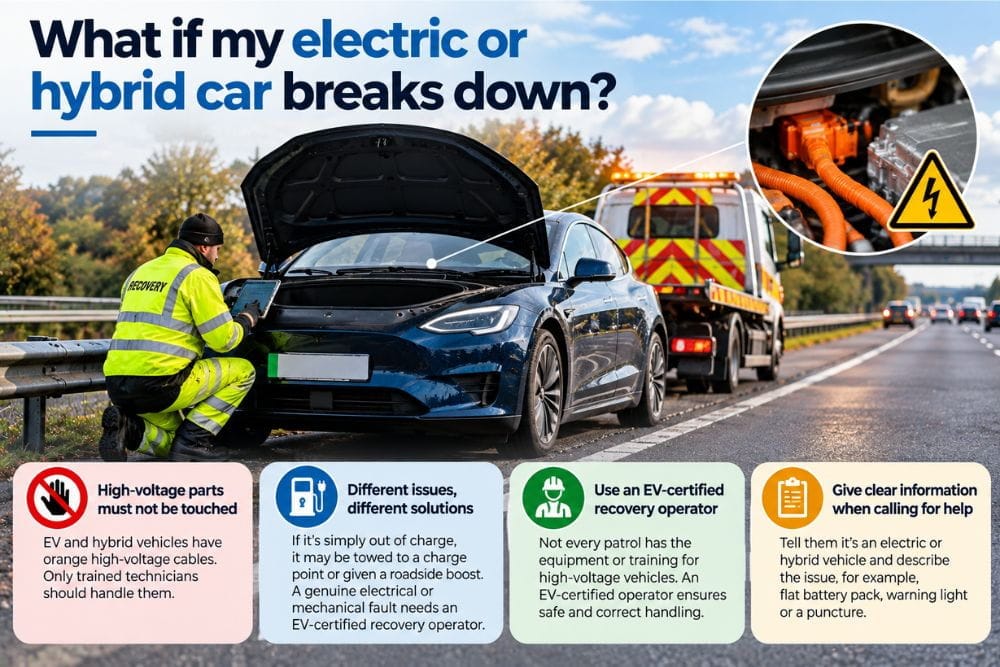
An EV or hybrid breakdown carries an added safety consideration: high-voltage cabling, usually coloured orange, runs through the vehicle and must not be touched by anyone other than a trained technician. This applies even if the fault appears unrelated to the electrical system.
Distinguishing a genuine fault from simply running out of charge matters for what happens next. A car that has run out of charge is typically towed to the nearest charge point or given a portable boost charge at the roadside; a car with an actual electrical or mechanical fault needs an EV-certified recovery operator, since not every patrol vehicle carries the equipment or training for high-voltage systems.
When calling for help, state clearly that the vehicle is electric or hybrid and describe whether the issue is a flat battery pack, a warning light, or a mechanical fault such as a puncture. This lets the provider send an appropriately equipped patrol on the first visit rather than a second, specialist one.
Who should I call first, 999, my breakdown provider, or a garage?
The choice depends on location and immediate danger, not on whether cover exists. Four scenarios cover almost every situation:
- Call 999 first when the vehicle is stopped in a live traffic lane, on a smart motorway with no hard shoulder, or when anyone is injured or in immediate danger. Speed matters more than diagnosing the fault in this scenario.
- Call your breakdown provider when the vehicle is safely off the carriageway, hard shoulder, lay-by, verge, or a residential road, and no one is in danger. This applies whether the fault is minor or serious.
- Call a local garage when the car has broken down at home, in a car park, or somewhere accessible without a recovery vehicle, and the fault appears minor enough for a same-day repair rather than a tow.
- Call 101 (non-emergency police) when the vehicle is causing an obstruction, blocking a junction, roundabout exit or narrow road, but there is no immediate danger to anyone. This gets the obstruction logged even before recovery arrives.
A quick decision test: if standing still next to the car for two minutes would put someone at risk of being hit, call 999. If not, call the breakdown provider or a garage depending on where the car is.
What details will a breakdown provider ask for?
Having these ready before the call speeds up dispatch, particularly if a patrol needs to be prioritised for a dangerous location:
- Full name and membership number, if a policy already exists
- Exact location: nearest motorway marker post, junction number, or a GPS pin from a phone app
- Vehicle registration, make and model
- A brief description of the fault, including any dashboard warning lights
- Number of passengers, and whether anyone has additional needs
- Mobile number, in case the patrol needs to call back
A location that’s hard to describe verbally, a rural lane with no obvious landmarks, for instance, is where a GPS-based location (from a maps app or the provider’s own app) saves the most time compared with trying to describe surroundings.
How much does it actually cost to break down without cover?
A one-off callout from a breakdown provider without existing cover typically costs more than routine membership, because the provider is pricing a single emergency visit rather than a policy taken out in advance. Towing distance, time of day and vehicle type all affect the final charge.
A local garage sending someone out to repair a minor fault or tow the car to their workshop is often cheaper than a national provider’s one-off callout, but garages are rarely available 24 hours a day, and a remote breakdown location can put a garage’s own recovery vehicle out of reach.
Buying cover after breaking down does not usually help immediately. Most policies activate roughly 24 hours after purchase, so a provider will still charge an emergency callout fee even if the driver signs up for a policy during that same phone call.
Can I buy breakdown cover after I’ve already broken down?
Buying cover is possible after a breakdown, but it rarely provides help for that specific incident. Providers typically apply a waiting period, commonly 24 hours, between purchase and the policy becoming active, precisely to prevent people buying cover only once they need it.
Calling a provider’s non-member or emergency line directly, rather than buying a policy through their website, is the faster route to help on the day. The driver pays a one-off callout fee instead of a subscription, and the provider dispatches a patrol under a pay-as-you-go arrangement rather than a membership.
What if I break down on a leased, finance or Motability car?
A leased vehicle usually carries manufacturer breakdown cover for as long as it remains under warranty, commonly around three years; the vehicle handbook lists the manufacturer’s preferred recovery partner and contact number.
A car on finance with no separate breakdown cover leaves the driver responsible for arranging recovery in the moment, though the finance provider or the dealership that sold the car sometimes has an obligation to assist or reimburse costs, this is a claim to raise afterwards rather than something a roadside patrol can resolve immediately.
A Motability vehicle includes breakdown assistance as standard as part of the scheme package, arranged through the Motability-approved provider rather than a separately purchased policy. The exact provider and contact number appear in the Motability paperwork issued with the vehicle.
What should I remove or do before leaving my car unattended?
Lock the vehicle if it is safe to walk away from it, and take valuables, including satnavs, bags and any visible electronics, out of sight or with you. An unattended car left visibly unsecured is more likely to attract attention or, in rare cases, be flagged as abandoned by local authorities if left for an extended period without arrangements for recovery.
Leave the hazard lights running even after locking the car, since the battery drain over a short wait is minor compared with the visibility benefit for other road users.
What are some small but important breakdown safety steps?
A distress signal, traditionally a white cloth or dedicated help pennant tied to the wing mirror, door handle or radio aerial, signals to passing patrols or police that a vehicle needs assistance, useful if a phone has no signal or battery. It is a low-tech backup rather than a replacement for calling for help.
Cars built from 2018 onwards in the EU and UK include an eCall or manufacturer SOS button, usually on the roof console, which connects directly to emergency services and transmits the vehicle’s location automatically. This is faster than describing a location verbally, particularly on an unfamiliar road.
Motorway emergency telephones, the orange boxes at roughly one-mile intervals, connect free of charge directly to Highways operators or the police and can pinpoint a location automatically from the phone’s position, which is faster than reading out a marker post number over a mobile with a poor signal.
Standing between the car and oncoming traffic, even briefly to retrieve something from the boot, removes the protection the vehicle itself provides as a barrier. Any item needed from the car is best collected once, before moving to a safe waiting position, rather than returning to it repeatedly.
What should be in my breakdown emergency kit?
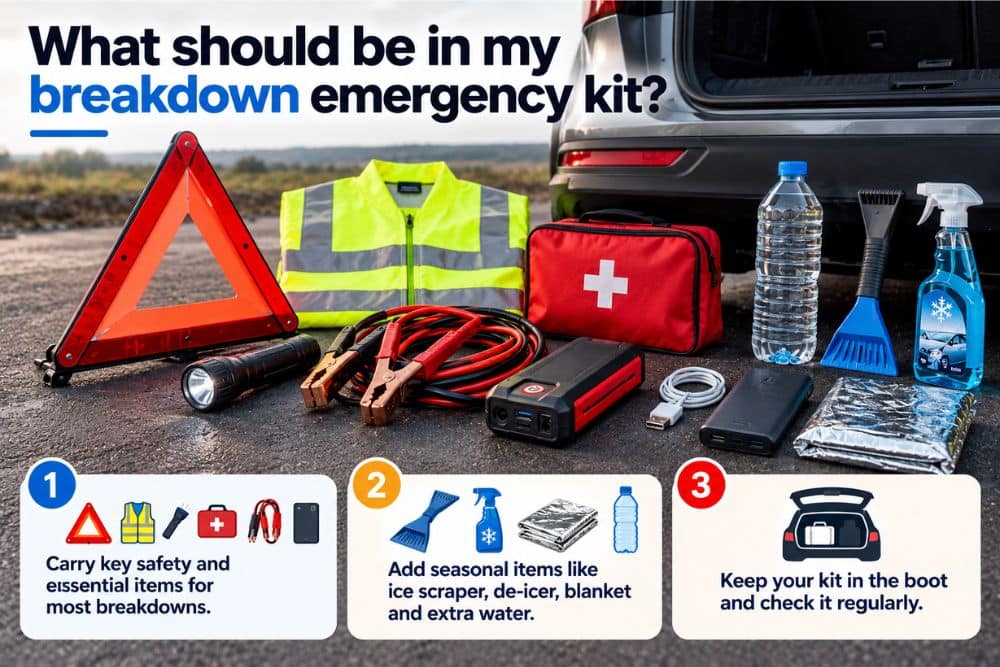
A core kit covers most situations: a warning triangle, a hi-vis jacket for each occupant, a torch, a basic first aid kit, jump leads or a portable jump-start pack, a phone charger or power bank, and drinking water.
Seasonal additions change what is genuinely useful. In winter, an ice scraper, de-icer and a blanket reduce discomfort during a longer wait; in summer, extra water and sun protection matter more, since a stationary car with the engine off loses air conditioning quickly.
What happens after the recovery vehicle arrives?
A patrol technician assesses the fault at the roadside first, and many faults, flat batteries, minor electrical issues, some tyre problems, are resolved on the spot without a tow. Diagnostic tools carried by most patrols identify electrical and software faults that would otherwise need a garage visit.
If the fault cannot be fixed roadside, the vehicle is towed either to the nearest garage under roadside assistance cover, or to a location chosen by the driver under vehicle recovery cover; the difference between these two cover levels is exactly this choice of destination.
Will a breakdown affect my insurance or no-claims?
A mechanical breakdown with no collision does not usually affect car insurance or a no-claims discount, since standalone breakdown cover operates separately from motor insurance. A breakdown that results from or causes a collision, for example, a tyre blowout leading to an impact, falls under the motor insurance policy instead, and a claim there can affect the no-claims discount depending on fault.
How can I reduce the risk of breaking down again?
Checking tyre pressure and tread depth, oil and coolant levels, and battery condition before a long journey addresses the most common causes of breakdown. A battery weaker than expected, a tyre below the legal tread limit, or a coolant level low enough to trigger overheating are all detectable during a five-minute check.
A dashboard warning light left unaddressed is the most preventable cause of an avoidable breakdown; the oil pressure and coolant temperature warnings in particular indicate faults that worsen quickly if driving continues.
Final thoughts
A breakdown becomes manageable once the sequence is clear: get the car to safety, make it visible, move people away from traffic, then decide who to call. That order matters more than which fault caused the stop.
Every difficult decision in a breakdown, whether to stay in the car, whether a triangle is safe to place, whether 999 or a breakdown provider comes first, depends on one factor: whether the vehicle is in a live traffic lane or safely off it. Settling that question first makes every other step straightforward.
Preparation shortens the wait rather than preventing the breakdown itself. A warning triangle to hand, a charged phone, and a clear sense of location turn a stressful stop into a brief, controlled one.
Frequently Asked Questions
Does breakdown cover include the cost of parts?
Does breakdown cover include the cost of parts?
This varies by provider and policy tier, some include minor parts such as fuses or a replacement battery within the callout price, while others charge parts separately from the labour and towing costs, so checking the policy terms before relying on it is worthwhile.
What should I remove from my car if I leave it unattended?
What should I remove from my car if I leave it unattended?
Valuables including bags, electronics and satnavs are best taken with you or kept out of sight, and the vehicle should be locked if it’s safe to walk away from it.
What is the distress signal for a broken-down car?
What is the distress signal for a broken-down car?
Tying a white cloth or a dedicated help pennant to a wing mirror, door handle or aerial signals to passing patrols or police that assistance is needed, useful as a backup when a phone has no signal or charge.
What’s the difference between roadside assistance and vehicle recovery cover?
What’s the difference between roadside assistance and vehicle recovery cover?
Roadside assistance covers a repair attempt at the roadside or a tow to the nearest garage; vehicle recovery adds the option of towing to a destination the driver chooses, such as home or a specific garage, rather than the nearest one.
Will a breakdown show up on my insurance record?
Will a breakdown show up on my insurance record?
A mechanical breakdown with no collision typically has no effect on motor insurance or no-claims status, since breakdown cover and motor insurance are separate products; a breakdown that leads to or results from a collision falls under the insurance policy instead.